Ostrołęka Kurpie Museum: Tickets, Free Sunday and Step-Free Access
The essentials: Main museum: plac Bema 8. Permanent exhibitions 12/8 zł, temporary 8/5 zł, defined family ticket 30 zł; Sunday entry free. Tue/Thu/Fri 9:00–17:00, Wed 9:00–18:00, weekends 10:00–16:00, Mon closed. Last entry 30 minutes before closing. Step-free route from Staromostowa.
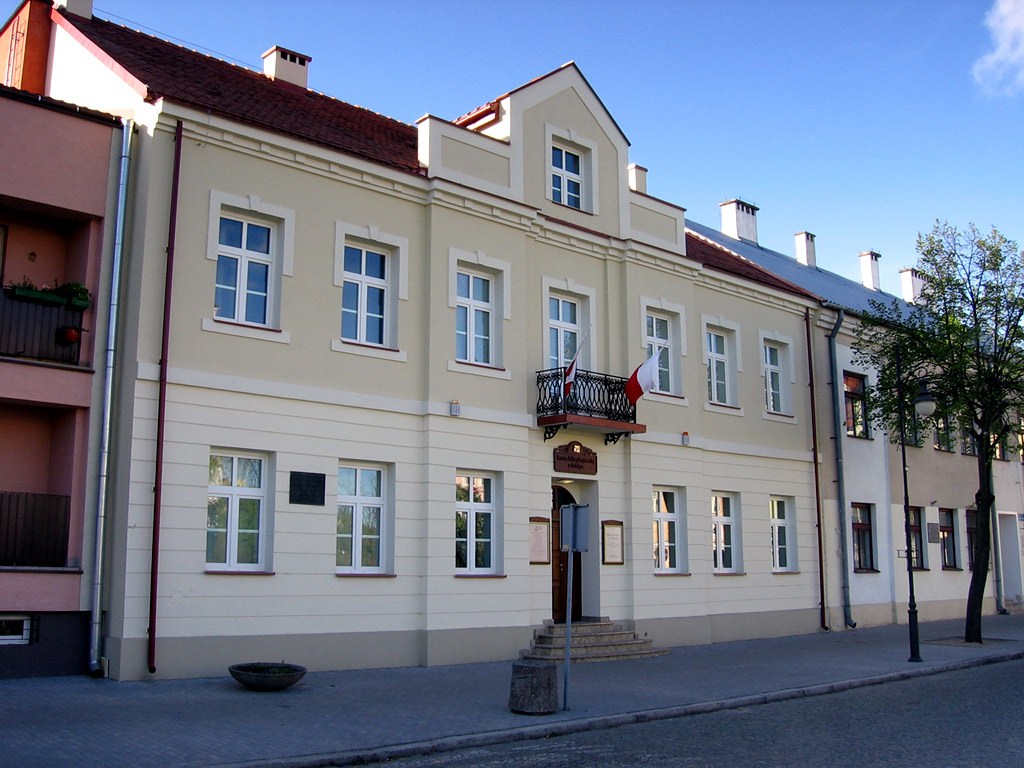
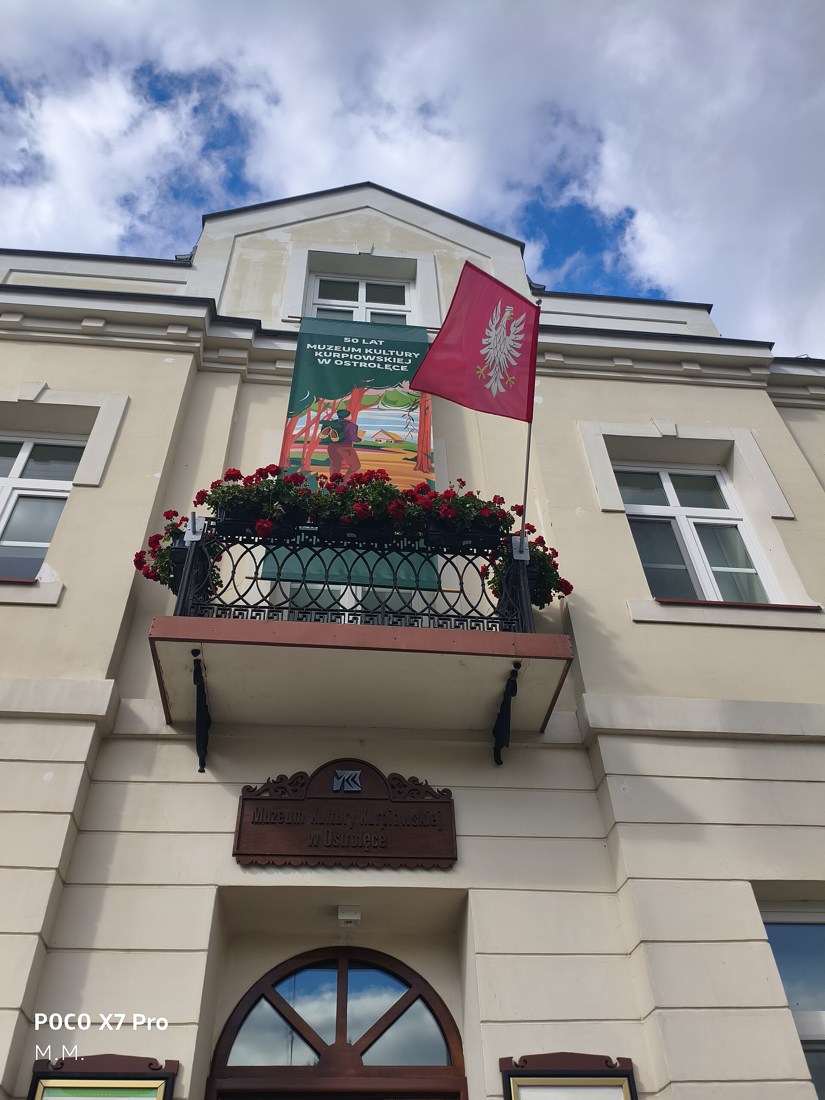
Cover: Museum of Kurpie Culture in Ostrołęka, photographed 3 May 2007. Historic exterior, not a current access survey. Photo: Piotr Brichacek (Briho) / Wikimedia Commons, CC BY-SA 3.0. Resized and recompressed.
The Museum of Kurpie Culture in Ostrołęka is a useful starting point for understanding the region beyond its familiar paper-cut decorations. Its permanent exhibitions connect town and countryside, the Narew River, everyday work, folk art and the lives of artists who left Poland after the November Uprising. The main museum is at plac gen. Józefa Bema 8, in a former post-office building, not at the separate battle mausoleum on Warszawska.
For a first visit, the main practical choices are straightforward: paid admission during the week and on Saturday, or the published free-entry Sunday. Access takes a little more planning. The front entrance has stairs, while the alternative route from Staromostowa leads to a lift. English interpretation is not clearly guaranteed in the visitor information, so anyone relying on an English guide or audio track should confirm it before travelling.
Main-museum hours and the last-entry rule
The museum's current visitor-facing website lists Tuesday, Thursday and Friday opening at 9:00–17:00, Wednesday at 9:00–18:00, and Saturday and Sunday at 10:00–16:00. Monday is closed to visitors. The library has a separate Monday-to-Friday 8:00–16:00 schedule. An open library or office does not mean the exhibitions are open, particularly on Monday.
The published visiting regulations set last admission to exhibitions at 30 minutes before closing. On a normal weekday closing at 17:00, that is 16:30; Wednesday's cut-off is 17:30, and the weekend cut-off is 15:30. Those times are the latest permitted entry under the regular schedule, not a sensible arrival target for seeing the permanent displays. Leave time for the cloakroom, tickets and any assistance you need.
You may encounter a different schedule in an older institutional directory entry. For planning, follow the current public museum site rather than combining fragments of conflicting timetables. Before a holiday or a journey made specially for one exhibition, check the latest notices or call 29 764 54 43. Regular weekly hours do not settle exceptional closures or whether every room is available that day.
Tickets: permanent and temporary exhibitions are separate categories
The detailed operator tariff lists permanent-exhibition tickets at 12 zł standard and 8 zł reduced. A family ticket is 30 zł for two adults with up to three children. Temporary exhibitions have their own listed prices: 8 zł standard, 5 zł reduced, or 30 zł for the same defined family group. The tariff says that Sunday entry is free for both exhibition categories.
Do not turn those separate lines into an invented all-exhibitions package. If you want permanent and temporary displays on a paid day, ask the ticket desk which products you need and what the total will be. Similarly, the family ticket is not automatically the cheapest choice for every family. Compare the ages, any free admissions and the exhibitions you actually want before buying it.
The tariff lists free entry for children under seven and for carers of preschool and school groups. Documents supporting reduced admission must be shown before purchase under the visiting rules. Karta Dużej Rodziny holders receive a published 50% admission discount, which cannot be combined with other discounts. If eligibility or the exact age boundary affects your budget, confirm it with the museum rather than assuming a foreign family or student card is equivalent.
The detailed tariff page carries an older publication date but remains linked from the current website; the headline 12/8 zł prices and free Sunday are also repeated in its current visitor footer. Workshops, family events and guided services have separate fees. Free exhibition entry should not be read as a promise that every event on Sunday is free or that a reserved activity is included.
Start with the town and countryside exhibition
The permanent exhibition Ostrołęka i Kurpie. Między wątkiem historii a osnową życia uses objects, archives, photographs, poetry and multimedia to show links between the town and surrounding Kurpie villages. It focuses on the interwar period, moving between public celebrations, ordinary work, markets, household production and traditional dress. The point is the relationship between communities, not a claim that all regional life followed one identical pattern.
Look for the contrast between urban trades and rural craft production. The museum describes material on shopkeepers and artisans, market exchanges, weaving and the economics of small households. Poetry by Izrael Sztern is part of the interpretation of Ostrołęka. The exhibition also includes historic film material from 1938, including work in a Kurpie household and traditional dress in a religious procession in Myszyniec.
For visitors new to the region, this is a good place to build context before concentrating on individual decorative objects. A spinning wheel or a costume makes more sense when connected to labour, income and public occasions. With children, choose one theme, such as how things were made or exchanged, rather than trying to read every panel. This is a suggested way to visit, not a promise of a supervised children's activity.
Paper cuts, the Narew and art in exile
The separate Wycinanka kurpiowska room traces the development of Kurpie paper cutting, including early forms used inside homes and the work of individual makers. The museum describes more than a hundred selected objects, with examples from the 1930s, photographs and an archival film from 1961. Two recurring forms are leluje and stars or circles. It is an opportunity to compare patterns closely rather than treating paper cuts as interchangeable souvenirs.
Ostrołęka. 6 x Narew approaches the city through its river. Its six-part structure takes inspiration from a die excavated at the medieval settlement during archaeological work in 1975. The exhibition connects routes and crossings, urban development, trade, military geography, floods and recreation. It gives an indoor introduction to why the Narew matters to the city's shape and history, even when the weather does not suit a long outdoor walk.
Another permanent display concerns the artistic work of soldiers of the November Uprising who went into exile. The museum names Teofil Kwiatkowski and Karol Malankiewicz, whose careers connect art with the events of 1830–1831 and life abroad. The permanent-exhibition list also includes Stanisław Skolimowski's work and a gallery of Polish art from the first half of the twentieth century. These make the museum broader than an ethnographic collection alone.
The step-free route is from Staromostowa
The museum's access declaration, reviewed on 31 March 2026, is specific about the entrance. The main door from plac Bema has steps. The alternative entrance from ulica Staromostowa has no architectural barriers on the described approach, is marked with a lift pictogram, and has a video intercom operated by the porter during museum hours. That entrance leads directly to the lift.
The declaration gives the lift-door width as 90 cm and the cabin as 100 cm wide by 140 cm deep. The adapted toilet is on the ground floor near the lift, to the right of reception. There is one designated accessible parking space in the internal courtyard, entered from Staromostowa. If that space or a particular cabin size is essential, ask in advance rather than treating a listed facility as a reservation or live availability check.
There are further details inside: a staff-operated hydraulic platform connects exhibition rooms on the first floor, and entrances to exhibition rooms in the Bema 9 part have small thresholds measuring 2 cm by 2 cm. These are reasons to describe the route accurately rather than calling every room simply barrier-free. Confirm the route and staff help for your own mobility aid before arrival.
Audio description, English and family facilities
The access declaration lists loan audio guides with audio description of permanent-exhibition rooms and a tactile example of a Kurpie paper cut. The visiting rules say audio guides are available at the ticket desk. Neither statement establishes a full English-language audio route. Ask which languages are available, whether a device must be reserved and whether there is a charge if audio interpretation is central to your visit.
The museum states that it has no induction loops. Assistance and guide dogs are admitted. A baby-changing facility is listed in the first-floor toilet in the Bema 9 building, separate from the ground-floor adapted toilet. These distinctions help when planning with children or with more than one access requirement. Check actual operating arrangements if you need to use a lift or platform to reach the facility.
Guides, workshops and photography rules
The listed guide charge is 30 zł per group of up to 30 people, with advance reservation required. This is a group-service fee, not a per-person ticket, and the tariff does not promise English at that price. The regulations say weekends are for individual visits without a guide or reservation; organised guided weekend visits require exceptional approval from the director. Do not arrive with a group expecting the weekday booking model to apply automatically.
Bags, larger belongings, umbrellas and outerwear must be left in the cloakroom under the rules; keyed self-service lockers are also provided. Food and drink are not permitted in exhibition areas. Personal photography without flash, extra lighting or a tripod is allowed subject to object-specific restrictions, but the museum's rules limit it to personal use without publication rights. Ask about permission before planning published or commercial photography. Admission is not a blanket photography licence.
Do not confuse the museum with its other sites
The battle mausoleum is a separate site at Warszawska 2A. Its winter timetable, October through March, is Tuesday to Sunday 10:00–15:00, with Monday closed. Its lift does not reach the viewing terrace, which the access declaration says is reached by narrow spiral metal stairs. The open-air Kurpie farmstead in Kadzidło is another separate destination with different terrain and access needs. Neither should be assumed to share the main museum's opening hours or admission ticket.
For the main museum, a useful first-visit allowance is roughly ninety minutes to two hours, depending on how closely you read and which galleries you choose. That is an editorial planning suggestion, not a compulsory visit length. Sunday suits a low-cost introduction; Wednesday offers the latest regular closing time. Check the current temporary-exhibition list before adding a special interest to your route, and leave time before the last-entry cut-off. Our Ostrołęka transport guide covers the separate question of travelling around the city.
Frequently asked questions
Is the museum free on Sunday?
The detailed tariff lists Sunday free admission for permanent and temporary exhibitions. Workshops and reserved services have separate fees.
Where is the step-free entrance?
Use the alternative entrance from Staromostowa, with video intercom, leading to the lift. The front entrance from plac Bema has stairs.
Can a group book a weekend guide?
Regular weekends are for individual unguided visits without reservations. Guided group weekend visits require exceptional approval under the museum rules.