Radom Village Museum: Winter Tickets, Walks and English Guides
The essentials: Radom Village Museum is at Szydłowiecka 30. Winter hours are 09:00-15:30 weekdays and 10:00-15:00 weekends, with ticket sales ending an hour earlier. Admission is 20/12 zł; a winter walking ticket is 10/6 zł and excludes interiors.
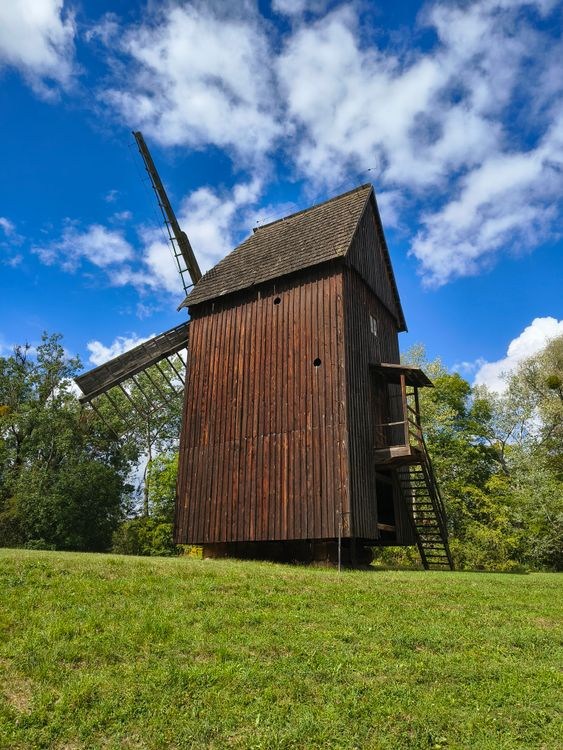
Cover: a wooden windmill in Opole, an illustrative open-air museum photograph, not Radom. Photo: Teodor Buhl / Pexels.
The Museum of the Radom Countryside, Muzeum Wsi Radomskiej, is an open-air museum, or skansen, rather than a single indoor gallery. Historic cottages, farm buildings, manor houses, windmills and watermills let you look at how people lived and worked in the Radom region. For newcomers to Poland, it is a useful way to put words such as zagroda, dwór and młyn into a physical setting.
A winter visit needs a different plan from a summer afternoon. The opening day is shorter, ticket sales finish before the museum closes, and a cheap walking ticket does not include interiors. English guiding is a separate service that needs advance arrangements. There is also an important distinction between facilities available now and accessibility improvements described in a November 2026 consultation.
Find the visitor entrance, not just the museum name
The museum lists its visitor entrance and ticket office at ul. Szydłowiecka 30, 26-600 Radom. Its contact page identifies city bus 18 as a way to reach that entrance. Use the address when planning a journey, then check the actual bus departure and return service for your date. The museum's statement that a route serves it is not a live timetable.
The contact page says passenger cars cannot park inside the museum grounds. Do not treat a large green area on a map as permission to drive in or park beside a historic building. Establish an appropriate parking arrangement before leaving the car, and keep access routes clear. The museum is primarily a place to explore on foot.
The institution also has an Oskar Kolberg museum branch in Przysucha. That is a different destination with its own address and visiting information. Make sure a saved map pin, ticket question or telephone enquiry refers to the Radom skansen, especially if you have reached the institution through a page that mentions both museums.
Winter hours and the earlier ticket-office cutoff
The current contact page lists 09:00-15:30 Monday to Friday and 10:00-15:00 Saturday and Sunday for its winter period, described there as 1 November to 28 March. The downloadable visitor rules dated 3 December 2024 give the same winter daily hours but define that season as 1 November to 31 March. This difference matters for a late-March trip, not for a November visit. Confirm the transition dates rather than assuming the two descriptions are identical.
Both the contact page and the 2024 rules say the ticket office stops selling or exchanging admission tickets one hour before closing. Under the ordinary winter schedule, that means planning around a 14:30 weekday or 14:00 weekend ticket-office cutoff. These are calculated from the published hours, not separate tour departure times. Arrive comfortably earlier if you want time to choose the correct ticket or discuss a route.
Holiday closures override the weekly pattern. The contact page lists closures including 1 and 11 November, Christmas Eve, Christmas Day and 31 December, as well as New Year's Day and 6 January. It lists the second day of Christmas as open. Check a date-specific notice before travelling over a holiday; a weekday opening time alone is not enough.
Choose between admission and a grounds-only walk
The museum's contact and tariff page lists a 20 zł regular ticket and a 12 zł reduced ticket. The winter walking ticket, bilet spacerowy, is 10 zł regular or 6 zł reduced and applies from 1 November to 31 March. The page explicitly says that this ticket does not include visiting interiors. This is the most important distinction when comparing the prices.
Choose the walking ticket only if an outdoor visit is what you want. It can suit someone interested in the buildings' shapes, the arrangement of farmsteads and the landscape. If you want furnished rooms, machinery or a specific indoor exhibition, ask which admission and guiding arrangements cover them before paying. A more expensive admission ticket should not be read as a promise that every historic doorway will be open at all times.
The tariff lists free admission for children under seven, while museum lessons for that age group have a separate charge. It also lists reduced-price categories and concessions linked to particular documents, including family cards and a Koleje Mazowieckie ticket. Eligibility and scope matter: do not assume a foreign student card qualifies, or that a discount on admission also reduces a guide or lesson fee. Bring the relevant evidence and ask staff to apply the correct category.
English guiding is a booking, not a walk-in guarantee
The tariff lists a guide service at 50 zł in Polish or 200 zł in English, with advance arrangements required. Its pricing rows specify a group of up to 20 people with one guide. The 2024 visitor rules separately describe groups of up to 25 per guide. Because those limits differ, use the tariff's 20-person pricing description when budgeting and obtain the museum's confirmation for your actual group size.
The newer rules say a foreign-language guide must be reserved at least seven days before the planned visit, with the reservation confirmed no later than five days before arrival. Without confirmation, the reservation is automatically cancelled. The contact page gives 697 566 083 for guided-visit reservations; the rules also list 48 332 92 81 extension 44.
Ask for the total for your group, the language, the buildings included, the meeting point and the confirmation procedure. Admission and the guide appear as separate tariff items, so do not present 200 zł as an all-inclusive family ticket. Also avoid copying old fixed tour departure times from the 2017 web rules: the 2024 document instead directs visitors to make a reservation.
What to look for beyond a row of old houses
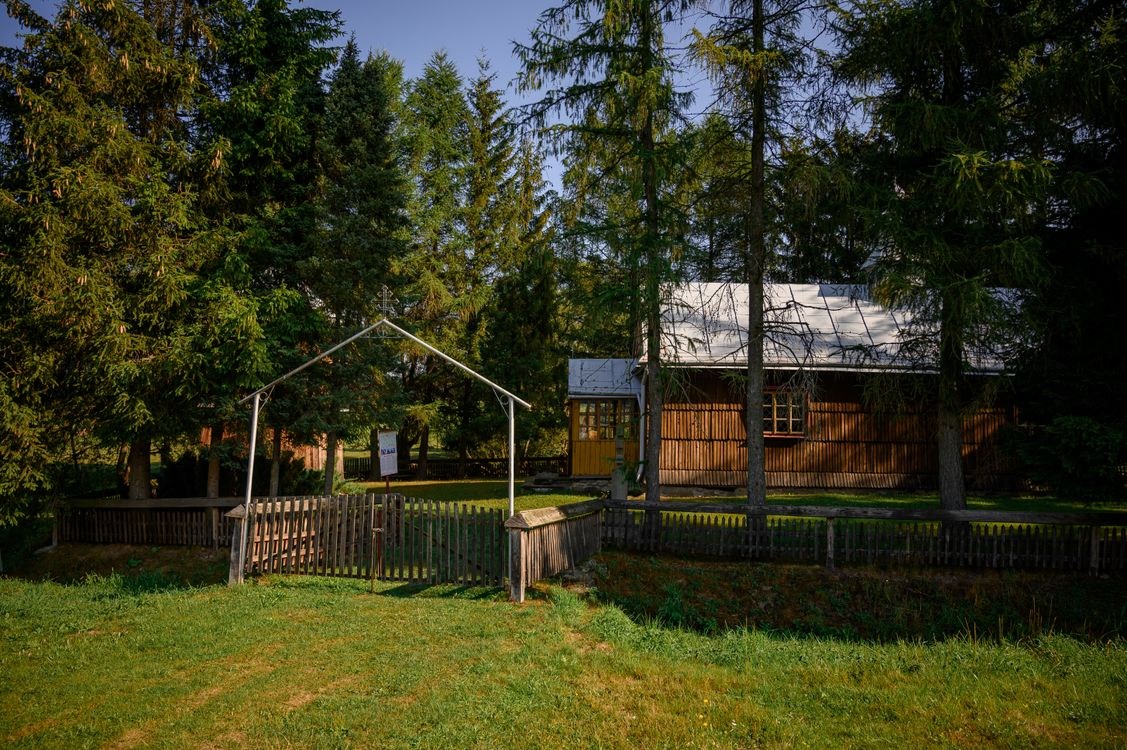
The museum's own introduction describes around 80 historic rural buildings across 32.5 hectares, including cottages, manors, a church, forges, windmills and watermills. Its purpose is to preserve the heritage of the Radom region, on the border of Mazovia and Lesser Poland. That regional focus is more useful than treating every building as a generic example of how all Polish villagers lived.
Look at a farmstead as a working arrangement. Where is the house in relation to storage, animals and the yard? What jobs needed a separate building? Which structures would have made a household more independent, and which suggest specialist work? These are questions you can explore outdoors even without reading every label or entering every room.
The permanent route Zdarzyło się kiedyś nad wodą, roughly 'Once upon a time by the water', connects buildings from riverside communities. The museum describes the sawmill from Molendy, watermills from Zofiówka and Zajączków, and buildings from Solec nad Wisłą. Its account explains how rivers shaped production and the arrangement of buildings, rather than serving only as scenery.
The Zofiówka mill is a good example of that industrial story. The museum dates it to about 1901 and describes a Francis water turbine powering its internal equipment. The building worked until 1974. That helps challenge the idea that a skansen shows only a distant, pre-industrial past. An exhibit description saying machinery can operate is not a promise of a demonstration during your visit; ask about any demonstration that matters to you.
Free Monday is different from a free November campaign
The downloadable December 2024 rules state that Monday admission is free and that temporary exhibitions are available in a limited scope. The older 2017 rules still online say temporary exhibitions are not available on Mondays. The newer document is the better reference for that distinction, but confirm which exhibitions will actually be accessible on the Monday you choose.
Do not confuse that weekly arrangement with the national 'Free November' promotion. The museum has its own notice explaining that its November admission tariff remains unchanged and that the ministry-funded programme does not apply to this institution funded by the Mazovian regional government. A free Monday does not make every day in November free, and neither removes the need to ask about paid guiding or activities.
Future accessibility plans are not today's facilities
A November 2026 consultation describes a proposed project involving conservation of four windmills, a milling exhibition and an accessible educational route. A linked page lists planned features such as sign-language interpreting, an induction loop, audio description, large print, tactile models, quiet activities and wheelchair-accessible workshop spaces. The wording is about planned provision, not confirmation that every feature is already operating.
If access support matters, describe the route or activity you want and ask what is available now. Useful questions include distances, surfaces, thresholds, access to particular interiors, toilets and a place to rest. The 2024 rules mention audio-description equipment for visitors with visual impairments, but availability and collection arrangements still need checking. Do not substitute a promising future project for a practical answer about your visit.
For a first winter visit, keep the plan simple: confirm the date and cutoff, decide whether you want grounds or interiors, arrange English guiding well ahead, and choose a few buildings to study closely. Dress for an outdoor walk and leave room to shorten the route if the weather or your group's energy changes. The reward is a clearer picture of rural life, work and technology, without arriving with the wrong ticket or a promise the museum never made.
Frequently asked questions
Does the walking ticket include interiors?
No. The winter walking ticket is 10 zł regular or 6 zł reduced and explicitly excludes interiors.
Can I arrange an English guide?
The tariff lists 200 zł for English guiding. The 2024 rules require booking at least seven days ahead and confirmation no later than five days before arrival. Confirm group size and admission costs separately.
Is November admission free?
The museum says the Free November programme does not apply to it. The 2024 rules separately provide free Monday admission with limited temporary-exhibition access.
Sources
- Museum: current contact, timetable and tariff
- Museum: visitor rules of 3 December 2024
- Museum: older 2017 visitor rules, for comparison only
- Museum: introduction and collections
- Museum: riverside route
- Museum: watermill from Zofiówka
- Museum: November tariff notice
- Museum: future-offer consultation
- Museum: planned accessibility features, not current facilities