Piła District Museum: Tickets, Free Sunday and Historic Interiors
The essentials: Piła District Museum is at Browarna 7. Open Tue-Fri 10:00-16:00, Sat-Sun 11:00-16:00; last entry 15:30. Standard/reduced tickets 17/15 zł, family 35 zł. Sunday permanent exhibitions free. Exhibition rooms have stairs and no lift; there is no adapted toilet.
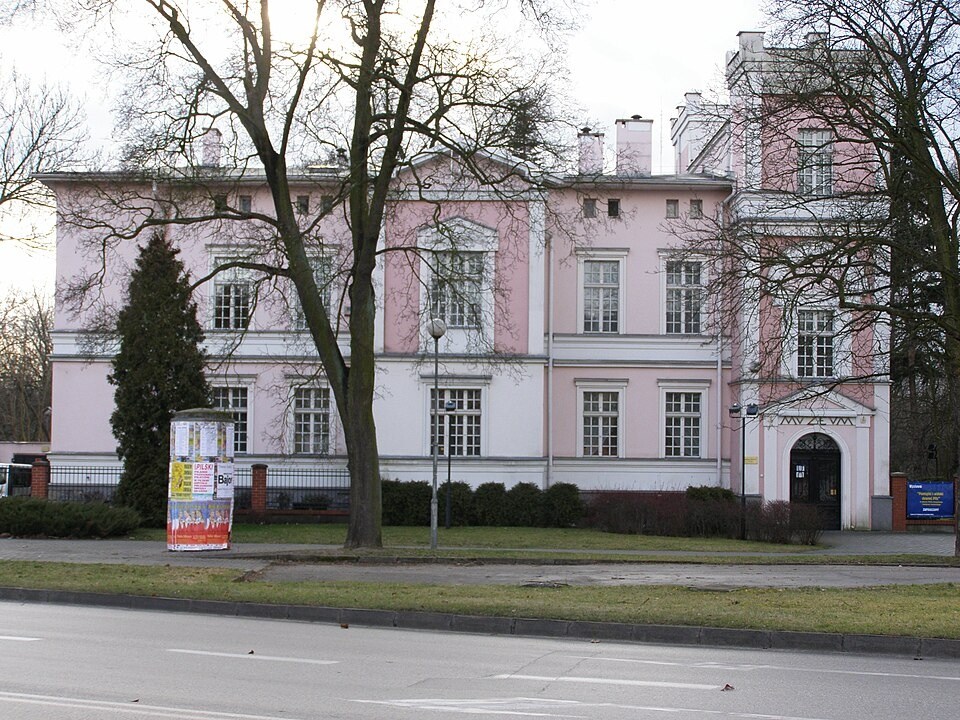
Cover: Piła District Museum in the former Polish consulate at Browarna 7, February 2008. Historic exterior, not a current access diagram. Photo: Albertus teolog / Wikimedia Commons, released into the public domain by the photographer. Resized and recompressed.
A small city museum with a specific collection
Piła's District Museum, Muzeum Okręgowe im. Stanisława Staszica, is at ul. Browarna 7. Its permanent display is a good fit if you enjoy furniture, ceramics, glass and the way domestic rooms reveal social history. It is not an open-air village, and it should not be confused with the institution's separate folk-culture museum in Osiek nad Notecią. That distinction affects the address, price, walking conditions and what you will actually see.
For an international resident, the appeal is the scale and detail: you can concentrate on a sequence of interiors and objects instead of trying to cover an enormous national collection. The building also has its own history as a former Polish consulate. The rooms are not, however, preserved with the consulate's original contents. The museum explicitly says that nothing of its former furnishings survived. The present exhibition is a curated collection, not an untouched diplomatic apartment.
Opening hours and the 15:30 admission deadline
The museum's current visitor information gives Tuesday-Friday opening as 10:00-16:00, with Saturday-Sunday opening 11:00-16:00. Monday is closed to visitors. The linked visiting regulations set last entry at half an hour before closing, which makes 15:30 the latest normal admission under this schedule. Arriving at 15:55 because the website says 16:00 closing is therefore not a workable plan.
These are the hours for the museum at Browarna 7. Do not transfer them to the Osiek branch. An organised lesson or group visit also needs its own arrangements; routine opening hours do not mean a specialist or guide will be waiting without a reservation. If you want a relaxed look at both the permanent rooms and a temporary exhibition, arrive well before the final-entry deadline rather than treating the last half-hour as a complete visit.
The current 2026 closure list includes 24, 25 and 26 December. Christmas Eve appears on that current list even though the older 2022 regulations do not list it. Use the current dated visitor information for holiday planning. A free-admission day does not override a closure, and this year's list does not settle the January 2027 holiday schedule.
2026 tickets: 17 zł standard, 15 zł reduced
The tariff introduced on 2 January 2026 gives 17 zł standard admission, 15 zł reduced admission and 35 zł for a family ticket at the Piła museum. The current visitor page and the dated announcement agree on those figures. Card payment is available. That is a more reliable budget than older directory entries with much lower prices.
The short tariff does not define the number or ages of people covered by the family ticket. If your choice depends on that product, tell the museum your party's composition before relying on it. For two standard-paying adults, separate tickets total 34 zł, so the word "family" does not by itself make the 35 zł product the cheaper choice. Children or other visitors may qualify for a reduction or exemption, which changes that comparison again.
The regulations link reduced and free admission to statutory categories and require supporting documents or the relevant declaration. Bring proof of any entitlement you intend to use. Do not assume that a foreign student card, a particular age or a family relationship automatically gives the same benefit without checking the applicable conditions. The published tariff provides a reduced price, not a complete eligibility decision for every visitor.
Sunday is free for permanent exhibitions, not every activity
The museum consistently describes Sunday free entry as applying to permanent exhibitions. That is useful for a first visit focused on the interiors, furniture and decorative arts. It is not a promise that temporary exhibitions, lessons, guiding or commercial photography are all free on Sunday. If a temporary show is the main reason for your visit, ask about its admission separately.
The regulations still make a valid ticket or invitation the basis of entry and say to retain it while visiting. Follow the ticket desk's instructions even when no payment is due. Free entry also does not remove the need to book an organised group or arrange an access requirement. The best budget plan is to separate three questions: which display you want, whether it is covered by Sunday free admission, and whether you are adding a paid service.
The permanent rooms: objects made to be used
The permanent exhibition is titled Meble i wnętrza mieszkalne od połowy XVIII do początku XX wieku - przedmioty piękne i użyteczne, describing furniture and domestic interiors from the mid-eighteenth to the early twentieth century, with beautiful and useful objects. Alongside furniture, the museum lists Polish and European decorative arts, painting and prints. Display cases include faience, stoneware, porcelain-related ceramics, artistic glass and silver.
A strong local thread is the work of Stanisław Mańczak's faience factory in nearby Chodzież. The museum explains the involvement of his brothers and of painter Bolesław Polankiewicz. One named object is the cobalt-decorated Five Senses vase, associated with recognition at the Paris exhibition in 1925 and Poznań in 1929. This gives a regional anchor to objects that might otherwise look like an anonymous collection of attractive ceramics.
Rather than memorising style names before arriving, use the rooms to compare shapes and functions. The museum identifies pieces such as a chess table, a sewing table, a secretaire and a chaise longue. These help explain what a room was for and how its occupants spent time. Look at the relationship between furniture and the smaller objects around it: display, writing, sociability and private leisure all leave different traces.
From gilded rooms to Art Nouveau
The gold room has a boudoir-like arrangement with gilded furniture in a French Rococo manner. The white room brings together Empire and Biedermeier furniture and equipment. The green room evokes a later nineteenth-century domestic interior, including historicist furniture and Dresden pieces decorated with painted porcelain plaques. These are exhibition arrangements illustrating styles, not proof that one family lived with every object exactly as displayed.
The Art Nouveau room occupies the former consul's office. Its flowing plant-inspired forms include furniture, glass and a tiled stove transferred from a Chodzież tenement. The museum also describes objects from Vienna and glass from the École de Nancy associated with Émile Gallé. A neighbouring gallery presents work by Juliusz Kędziora and bentwood furniture from Thonet. Polish Art Deco is represented through glass from the Niemen and Hortensja works.
This is an especially useful museum for visitors who like design but do not want a purely technical account. You can follow changes in line, decoration and materials from room to room. For children, comparing an unfamiliar furniture item with something used at home can make the visit more engaging. It remains a museum collection, not a hands-on playroom: the rules prohibit touching exhibits or sitting on the furniture.
The current temporary exhibition runs into January
As checked on 27 November 2026, the museum advertises Cunctis patet ingressus for 15 October 2026 to 15 January 2027. It draws on the collections of Anna and Paweł Maciukiewicz. The description includes European ceramics from the eighteenth to twentieth centuries, textiles from the seventeenth to twentieth centuries, historic clothing, personal memorabilia connected with Polish cultural figures, noble dress accessories and arms.
That combination makes it a different proposition from the permanent domestic interiors, even where the subjects overlap. The collection includes material associated with Henryk Sienkiewicz, Jan Matejko and Wojciech Kossak, alongside items such as kontusz belts and sabres. Check current access and admission if this show is your priority, especially around the December closures. An advertised end date is not a statement that every intervening day is open.
The site also retains a page for Staszic i jego czasy, but that exhibition's published dates were 6 November 2025 to 22 February 2026. It is not a current November 2026 attraction merely because its page remains online. Likewise, the museum's name does not mean that every visit is a dedicated exhibition about Staszic's life.
Access limitations: stairs, no lift, no adapted toilet
The accessibility declaration, last checked by the museum on 31 March 2026, is clear about the main limitation: stairs lead to the exhibition rooms and there is no lift. It also says there is no toilet adapted for visitors with particular access needs. A wheelchair user should not read the presence of paved approaches or a staff bell as evidence of a step-free museum route.
The declaration mentions that staff can carry a wheelchair. That is not equivalent to independent wheelchair access, and it should never be assumed suitable for a person or their equipment without direct discussion. Contact the museum about what assistance is actually possible and whether it meets your needs. The main entrance is from Browarna; a bell is on the left before entering.
A free car park is described beside the building, but there are no designated spaces for visitors with particular access needs. The declaration also lists no induction loops, Braille or contrast/large-print signs, and no sign-language interpreter service. Assistance and guide dogs are allowed under the accessibility statement. These are practical limits to plan around, not reasons to promise an inaccessible visit will be easy.
Groups, children, photography and the separate Osiek branch
The linked regulations say organised groups of at least ten should notify the museum several days ahead, and a group entering the display must not exceed 30. Minors must remain under parental or guardian supervision. Leave the coats, bags, backpacks and umbrellas specified by the cloakroom rules, and follow staff directions. The current tariff's 35 zł preschool-group guide line should not be applied to every group as a universal tour price.
Amateur photography and filming during a visit are free under the rules, without flash, a tripod or additional artificial lighting. The same document limits those images to private use without further permission. The current visitor page separately lists commercial/professional photography at 150 zł per hour and wedding sessions at 100 zł; commercial arrangements require agreement, not simply turning up with equipment.
Finally, Osiek nad Notecią is a separate outing at Dworcowa 12, with an open-air setting and its own tariff. The shared 2026 announcement gives 25 zł standard, 20 zł reduced and 55 zł family admission there, not Piła's 17/15/35 zł. For the Browarna museum, contact [email protected] or 67 212 71 37 / 67 211 07 80. Ask about your actual display, party, language and access needs rather than treating two branches as interchangeable.
Frequently asked questions
Is the whole museum free on Sunday?
The published free Sunday offer covers permanent exhibitions. Check temporary exhibition and extra-service admission separately.
Is there a lift to the exhibitions?
No. The March 2026-reviewed access declaration says stairs lead to the exhibition rooms and there is no lift or adapted toilet.
Is Osiek covered by the Piła ticket price?
Do not treat the branches as interchangeable. The 2026 notice lists separate Piła 17/15/35 zł and Osiek 25/20/55 zł standard/reduced/family tariffs.