Śmiełów Palace: Mickiewicz Museum Tickets, Free Tuesday and Access
The essentials: Śmiełów 1, 63-210 Żerków. Tuesday-Friday 09:00-16:00; weekends 10:00-16:00; Monday closed. Ticket desk closes at 15:30. Normal 15 zł, reduced 10 zł, ages 8-26 listed at 1 zł; Tuesday free. Entrance steps, no lift or accessible toilet. Holiday exceptions apply.
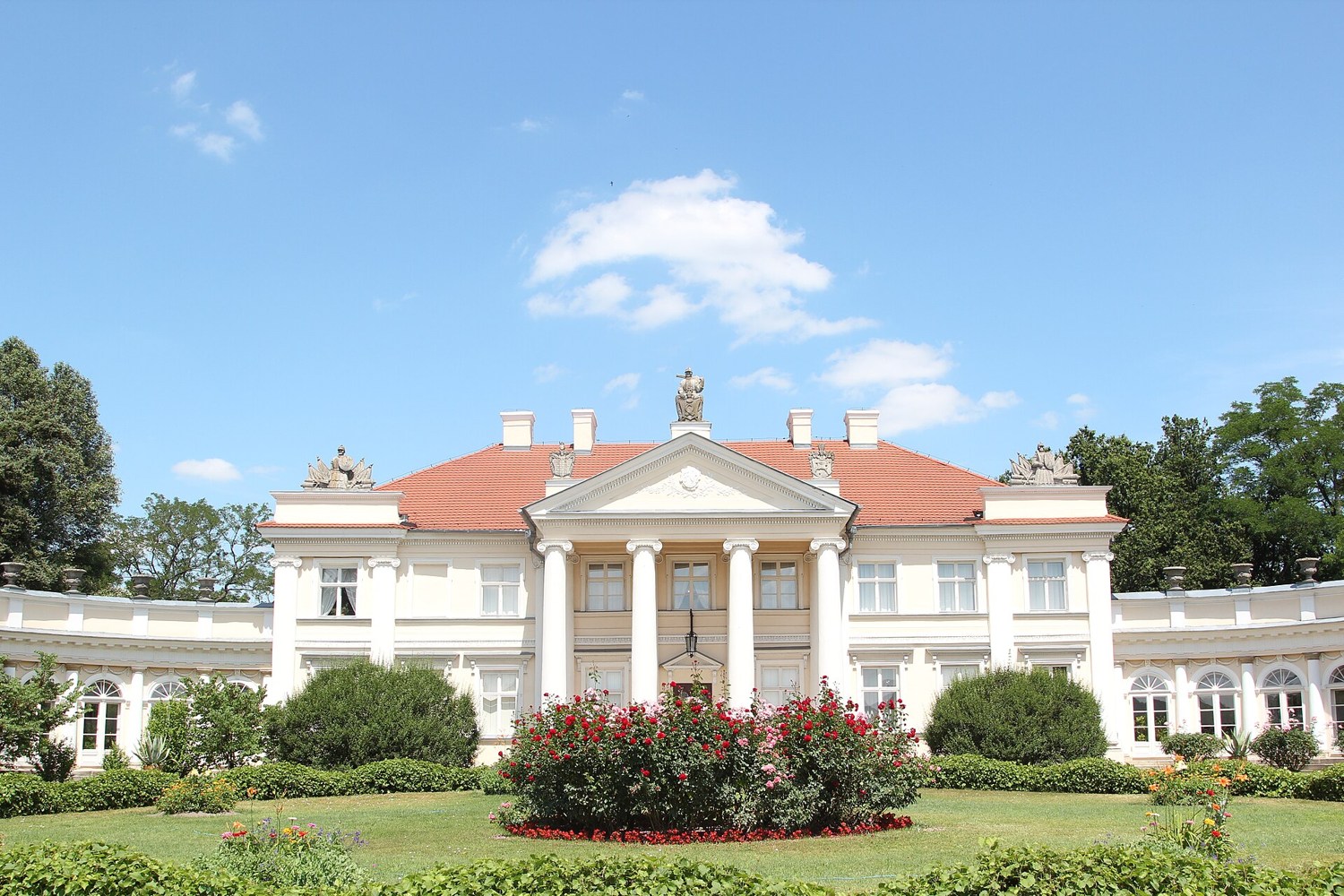
Cover: Śmiełów Palace photographed on 22 June 2019. Archival summer view, not a current seasonal or access survey. Photo: Fallaner / Wikimedia Commons, CC BY-SA 4.0. Resized and recompressed under the same licence.
Śmiełów is a useful place to understand why Adam Mickiewicz matters beyond the school reading list. The museum combines a country palace, rooms arranged in an early nineteenth-century style, literary collections and a landscape park. For an international resident, that makes it possible to approach Polish Romanticism through a real place rather than begin with a long poem in an unfamiliar language.
The practical details deserve attention before setting out. Tuesday admission is listed as free, weekends start an hour later than weekdays, and the historic building has significant access barriers. This guide separates those confirmed visitor rules from the stories associated with the poet's stay, so a visit can be planned around what the museum actually offers.
Where to go and which timetable to use
The address is Śmiełów 1, 63-210 Żerków. The institution is the Adam Mickiewicz Museum, a branch of the National Museum in Poznań. Use the village name and full address when arranging transport. This is not a museum in central Poznań, and the parent institution's city address is not the entrance to this palace.
The branch's official visitor page lists Tuesday to Friday from 09:00 to 16:00, and Saturday and Sunday from 10:00 to 16:00. Monday is closed. The ticket office closes 30 minutes before the museum, which means 15:30 under that published timetable. Arriving just before the desk closes leaves little time for the rooms, so build in more time than the final ticket-sale deadline.
Holiday rules override the ordinary pattern. The official page lists closures on 1 January, Good Friday, Holy Saturday, Easter Sunday, Easter Monday, Corpus Christi, 1 November, 24-26 December and 31 December. It lists Sunday hours for 6 January, 1 May, 3 May, 15 August and 11 November. Check the branch page again for a holiday visit rather than assume a normal Tuesday or weekend timetable applies.
Admission: 15 zł, concessions and free Tuesday
The published tariff is 15 zł for a normal ticket and 10 zł for a reduced ticket. The table also lists a 1 zł ticket for children and young people aged 8-26, and Tuesday admission at 0 zł. These are the branch's own figures, not a general estimate for National Museum properties.
Take identification that supports any age-based or other concession, and confirm eligibility at the desk. The short tariff does not explain every combination of age, nationality and entitlement, so do not assume a reduced rate automatically applies to every member of an international group. Ask about younger children rather than extrapolate a price from the 8-26 category.
Free Tuesday can make this a low-cost cultural stop, but it is still subject to opening days, holiday closures and any separate event arrangements. A concert or workshop is not automatically included because the ordinary museum ticket is free that day. The ticket office contact published by the museum is +48 62 740 35 14 and [email protected].
Why Mickiewicz came here in 1831
The museum's historical account places Mickiewicz at Śmiełów in mid-August 1831, during the November Uprising. He stayed with the Gorzeński family for about three weeks. The residence was near the border between Prussian and Russian-controlled territory, and the estate was involved in the movement of patriotic material and volunteers.
According to that account, the poet used the assumed name Adam Mühl and presented himself as a relative of the owners and a teacher to their sons. He attempted to cross towards the uprising near Komorze, but returned as defeat approached. This background explains why a country-house visit belongs to a much larger story about borders, exile and political independence.
For readers new to Polish history, the most useful distinction is between the location and the later literary memory. Mickiewicz really stayed at the estate. The museum also discusses local traditions and experiences as inspirations for themes in Pan Tadeusz. That does not mean every room or object is a direct surviving scene from the poem, or that the poem was written in this palace.
Read the building as well as the displays
The late eighteenth-century palace was designed by Stanisław Zawadzki. Its horseshoe plan, Ionic entrance portico, arcaded connecting galleries and side buildings make the exterior part of the visit rather than a decorative wrapper around the collection. Look at the relationship between the central house and the wings before going indoors.
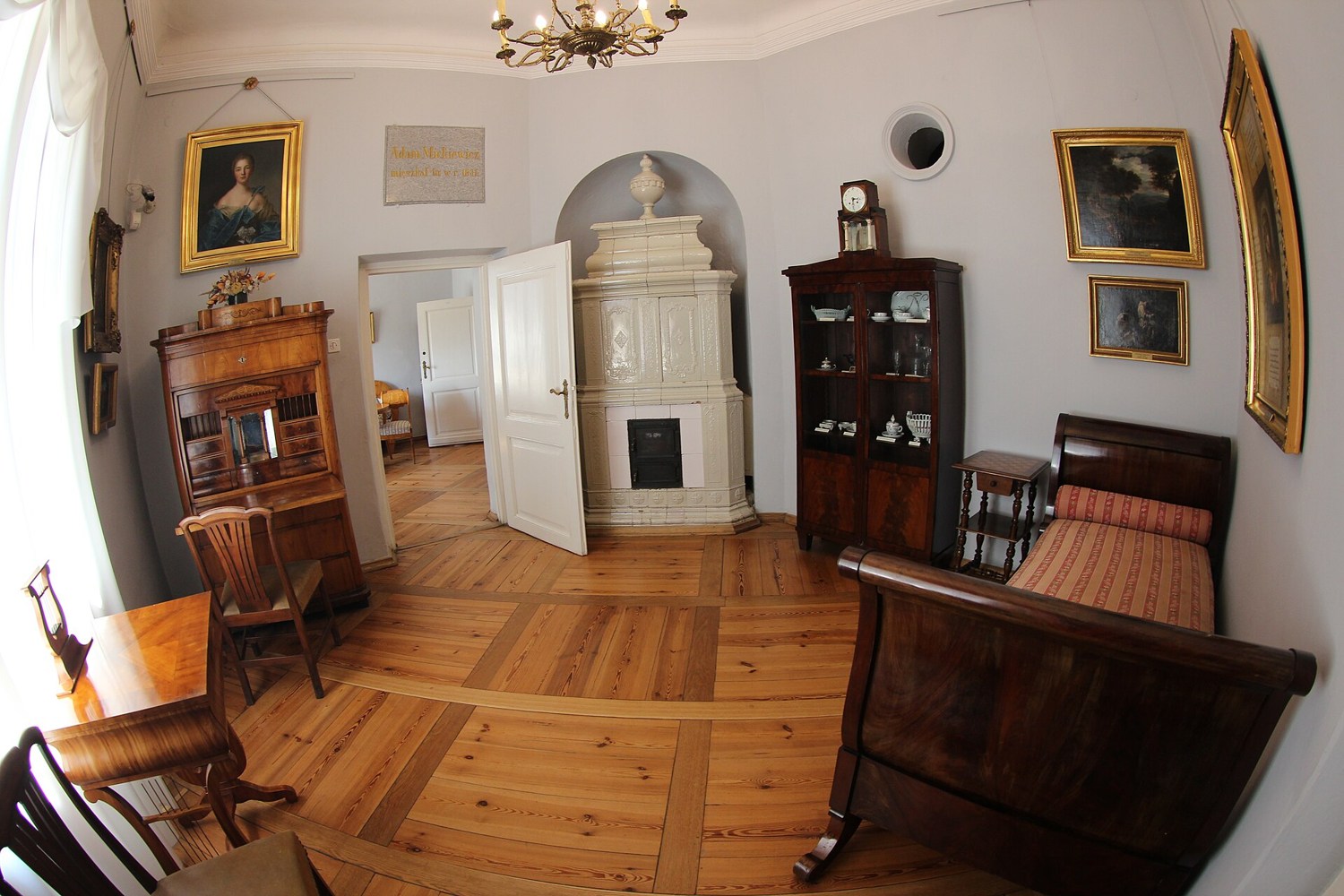
The museum credits Michał Ceptowski with the stucco decoration and Antoni and Franciszek Smuglewicz with interior painting. These details place the house within the tastes of its owners and the architectural culture of its period. Even without reading every Polish label, visitors can compare formal reception spaces with the more personal impression created by furniture, portraits and domestic objects.
The official description says the interiors are arranged in a style associated with around 1830. Treat them as a museum presentation, not an untouched home frozen on the day Mickiewicz left. The palace later went through dispossession, damage and other uses, which is important when interpreting reconstructed room settings.
What the museum collects
The branch describes collections connected with Mickiewicz's life, writing and reception, alongside material associated with the Romantic period and the families who owned Śmiełów. Its anniversary account discusses portraits, manuscripts, early editions and evidence of the poet's links with Wielkopolska. It also mentions objects connected with Juliusz Słowacki and Cyprian Kamil Norwid.
Those are descriptions of collection strengths, not a promise that every named item will be on display on a particular day. Works can move between storage, exhibitions and loans. If there is one manuscript or object you particularly want to see, ask the museum before travelling rather than rely on an old exhibition photograph.
The Gorzeński and Chełkowski families are another useful thread. The museum explains how the later owners developed remembrance of Mickiewicz, including a monument in the park in 1931. That turns the house into a place about both the poet and the way later generations chose to remember him.
The park is part of the story
The official overview describes a landscape garden of nearly 14 hectares around the northern and eastern sides of the residence. The park's own page explains how older trees, curving paths, the Lutynia river's historic course and carefully opened views were used to make the grounds feel larger and connect them with the surrounding countryside.
One of its useful concepts is the borrowed landscape: views beyond the formal estate became part of the composition. The museum points to the view towards Brzóstków and the surrounding hills. Rather than race through the grounds as a shortcut, look for changes in the view as paths turn and the palace recedes behind the trees.
The story of Mickiewicz planting an oak after news of Warsaw's fall belongs to the site's commemorative tradition. The museum presents it as a story associated with the poet and explains the later symbolic importance of the tree. Do not mistake that account for a claim that the original tree is still standing. For winter visits, ask about the current park arrangements and suitable paths; a landscaped park is not a promise of cleared, level or illuminated walking routes.
Access: do not rely on a generic wheelchair-friendly label
The official visitor page is clear: the museum occupies a two-storey historic residence without a lift, the main entrance has steps, and there is no accessible toilet in the building. The detailed access declaration goes further, describing the entrance steps and lack of lift as barriers that make the building inaccessible to wheelchair users.
For this branch, the declaration also lists no designated accessible parking space. It says internal stairs have handrails but lack contrasting markings, and assistance dogs and guide dogs are allowed. These are branch-specific statements. Other National Museum properties have different arrangements, so information about a lift or ramp elsewhere in the organisation cannot be transferred to Śmiełów.
The declaration lists an induction loop at the ticket desk and portable FM hearing-support equipment used during staff-led tours. Ask in advance about availability, how the equipment works with your own device, and the route your group would take. If you need step-free entry, an adapted toilet or support with sensory needs, obtain a direct answer before committing to the trip.
Language, children and a sensible visit plan
The official visitor page gives education contacts for lessons, workshops and guided visits: +48 62 740 35 16 or +48 62 740 35 22, and [email protected]. Use those contacts to ask about an English-language visit and the level of explanation suitable for children. The published contact route is not confirmation that an English-speaking guide will be available without booking.
A practical approach is to choose a few themes rather than attempt every literary reference: the poet travelling under an assumed identity, the house as a borderland meeting place, and the later creation of a national memory. With children, the building and the park can provide concrete starting points before discussing manuscripts or literary influence.
Finally, check the branch page for current exhibitions. The fiftieth-anniversary exhibition advertised for 21 June to 23 December 2025 is historical, not a current 2026 programme. Confirm opening and access needs, arrive well before the ticket desk closes, and keep the museum visit separate from any unverified promise of transport, food or an event. That produces a more reliable outing than treating a palace photograph as a complete day-trip plan.
Frequently asked questions
Is the Mickiewicz Museum free on Tuesday?
The official branch tariff lists Tuesday at 0 zł. Ordinary opening days and holiday closures still apply; special events may have separate arrangements.
When does the ticket office close?
The published museum closing time is 16:00, with the ticket office closing 30 minutes earlier, at 15:30.
Is the palace wheelchair accessible?
The official declaration says entrance steps and the lack of a lift make the building inaccessible to wheelchair users. There is no accessible toilet or designated accessible parking space listed for this branch.
Sources
- official branch hours, tickets and contact
- official architectural and hearing access declaration
- official palace and literary history
- official landscape park explanation
- official anniversary history and collection
- past2025anniversary exhibition, not current programme
- independent visitor reference
- regional visitor reference