Bolesławiec Ceramics Museum: Palace, Tickets and Workshops
The essentials: The main Ceramics Museum is at Zgorzelecka 28/29, not the old Mickiewicza address. Tickets 20/10 zł, school pupil/student 5 zł; Thursday free. CDTG at Kutuzowa 14 is separate, open Tue-Sat 10:00–16:00. Combined tickets 25/12 zł, school pupil/student 6 zł. Reserve workshops ahead and check access facilities directly.
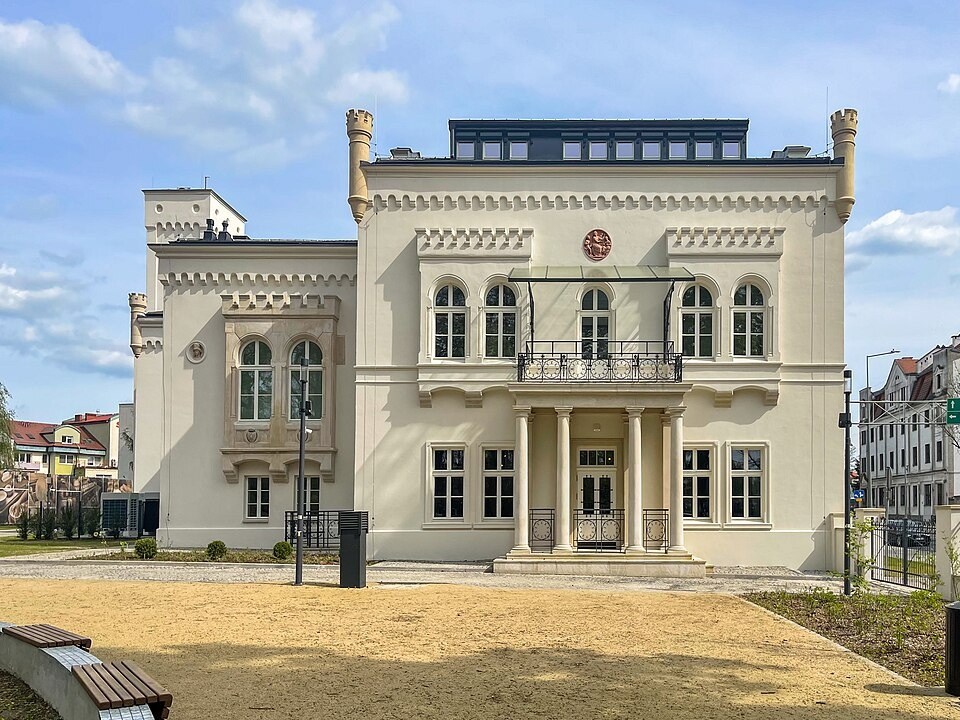
Cover: garden elevation of the Pückler palace, the museum's current home, photographed on 13 April 2024. Not a current entrance-access survey. Photo: Tomasz Gąsior / Wikimedia Commons, CC BY-SA 4.0. Resized and recompressed.
Go to the new palace, not the old museum address
Bolesławiec is an easy place to recognise a pottery pattern and a harder place to understand how it developed. The Ceramics Museum gives that familiar tableware a longer story: local clay, brown glazed jugs, changing workshops and the later arrival of sponge-stamped decoration. Its main exhibition is now in the Pückler palace at ul. Zgorzelecka 28/29. The museum opened this new home on 3 April 2024. Older guides pointing visitors to Mickiewicza 13 are not directions to the current palace exhibition.
There are two different visits to consider. The palace is the main museum, with historic ceramics and the building itself. The Centrum Dawnych Technik Garncarskich, usually shortened to CDTG, is the Old Pottery Techniques Centre at ul. Kutuzowa 14. It has its own exhibition, a historic kiln and bookable practical workshops. A combined ticket links them, but they do not share identical hours. Decide whether you want a collection visit, a making activity or both before choosing your day.
Winter hours and the Thursday option
For the main museum, the published October-to-April timetable is Tuesday and Thursday 10:00–17:00, Wednesday and Friday 09:00–16:00, Saturday 10:00–16:00 and Sunday 11:00–16:00. Monday is closed. These are exhibition hours, not the separate Monday-to-Friday 08:00–16:00 secretariat hours shown elsewhere on the website.
From May through September, the main museum publishes Tuesday and Thursday 10:00–18:00, Wednesday and Friday 09:00–17:00, Saturday 10:00–17:00 and Sunday 11:00–17:00. Thursday admission is free. That makes it a useful choice if your dates are flexible, although a free exhibition ticket does not make a guided service or workshop free.
CDTG publishes exhibition opening Tuesday to Saturday 10:00–16:00, with workshops Tuesday to Saturday 10:00–15:00 by advance arrangement. Do not plan an ordinary Sunday two-site visit on the assumption that the palace timetable also applies there. Its tariff also lists free Thursday exhibition admission. Check both sites' holiday notices before travelling: for the main museum, the 2026 notice lists closure on 24–26 December, opening 11:00–17:00 on 27 December and 09:00–13:00 on 31 December.
Tickets: palace, pottery centre or both?
The main museum tariff is 20 zł standard and 10 zł reduced, with a separate 5 zł school pupil/student ticket. Children under seven enter free. The published Bolesławiec resident-card and local large-family-card rates are 10 zł. These are named local card categories, not a promise that any residence document or family card earns the same price. Bring the evidence for the category you intend to use and ask the desk if your document qualifies.
CDTG alone is 10 zł standard and 5 zł reduced. Its school pupil/student rate is also 5 zł, as are the two named local-card categories; children under seven are free. A combined palace-and-CDTG ticket costs 25 zł standard, 12 zł reduced or 6 zł for the school pupil/student category. The local-card combined rate is 12 zł. For a full-price adult who wants both exhibitions, that is 5 zł less than buying the two standard tickets separately.
Ask about the combined ticket before paying for the first site. The tariff identifies the two institutions it covers, but do not assume an unlimited validity period or that it automatically reserves a workshop. On a Thursday, the free exhibition arrangements may matter more than the combined-ticket saving. Keep admission, guiding and a practical class as separate parts of your budget.
What to look for beyond the blue-and-white patterns
Start by comparing shapes and surfaces rather than trying to remember every maker. The museum's pre-1945 collection description connects pottery to clay deposits around the Bóbr and Kwisa rivers. One of its earliest objects is a vessel from the second half of the thirteenth century, found during archaeological work in the town's market square in 2007. Other excavated material shows how many uses ceramics had long before today's matching table sets.
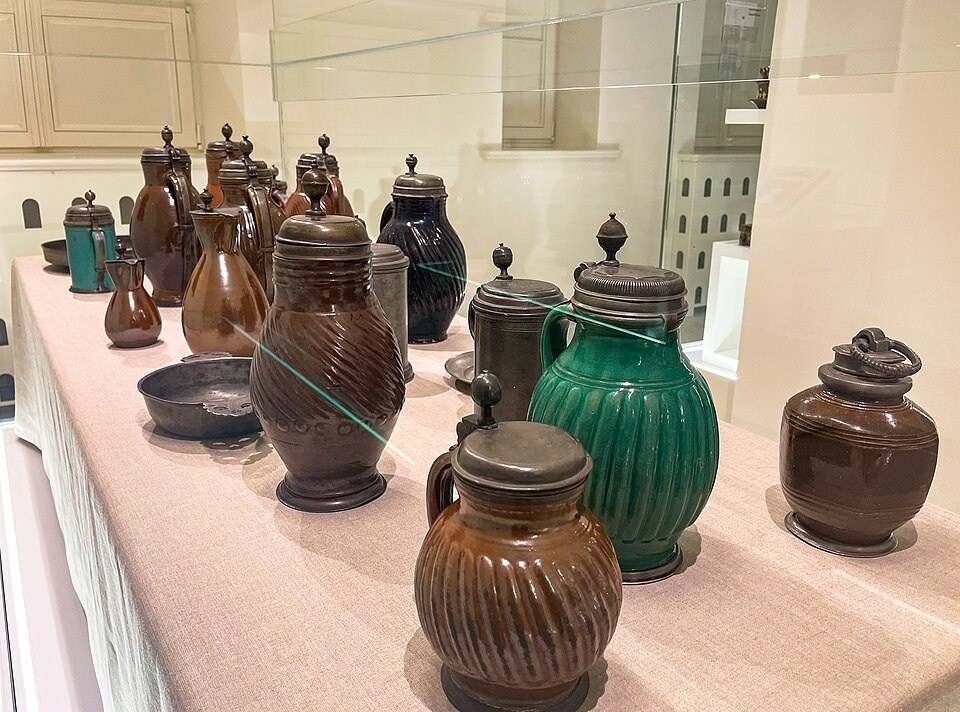
Brown earth glazes, green glazes, raised decoration and metal lids give the older jugs a different appearance from the pieces many visitors associate with Bolesławiec. Some vessels were fitted with metal around their rims or bases to extend their working life. Look at the relationship between the practical object and its decoration: a jug might be everyday equipment and still carry carefully made reliefs, lettering or religious imagery.
The familiar sponge-stamped decoration arrived much later, around 1882 according to the museum's account. The Royal Ceramic Technical School, founded in 1897, then connected artistic design with materials, glazes and production methods. This is a useful way to read the displays: local craft was not frozen in one pattern. New teaching, equipment and designers changed both what could be made and what customers wanted.
Another attention-grabber is the copy of the Great Pot. The original, made by master Joppe in 1753, was 2.15 metres high, held 1,970 litres and weighed 600 kilograms. Its later fate after the wartime loss of the collections is uncertain. Describing the present display as the surviving original would miss an important part of the story. With children, comparing its scale with an ordinary jug is a more approachable starting point than a long sequence of dates.
The palace is part of the visit
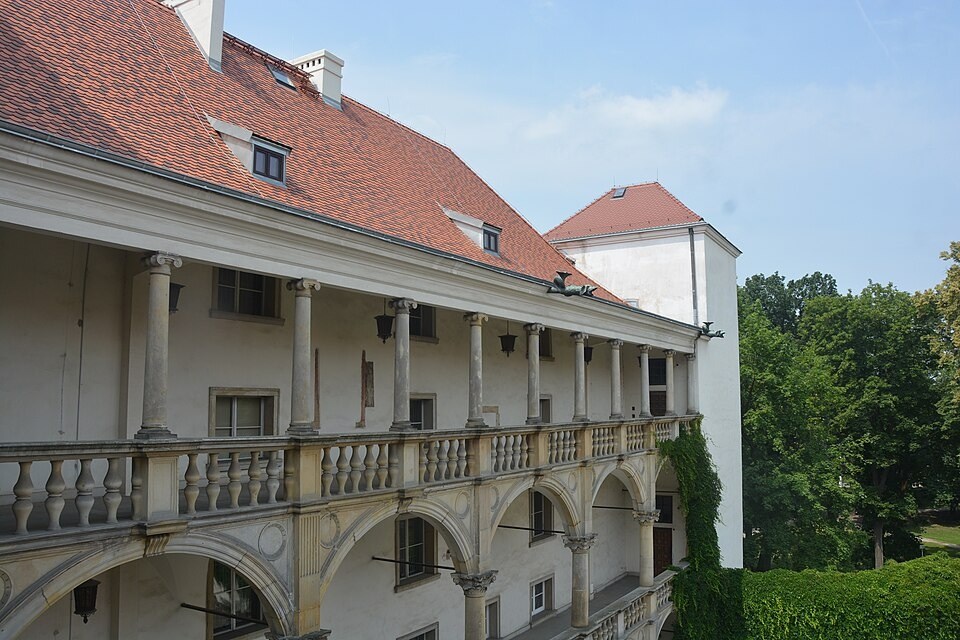
The building's present neo-Gothic form dates from an 1857 rebuilding for Count Pückler. Its three wings form a roughly U-shaped plan, with a prominent crenellated tower. The museum's building history also records later public uses, including a youth home, reading room and library after the municipality bought it in 1920. It is worth looking at the architecture rather than treating the palace as a neutral container for the collection.
The cover photograph shows the restored palace from the garden in April 2024, shortly after the new museum opened. It is a historic view of the correct building, not a photograph of today's queues, weather or accessible entrance arrangements. If recognising the destination matters, save the street address as well as the museum's name. That avoids being sent to an older branch listing by a guidebook or map result.
What CDTG adds at Kutuzowa 14
The pottery centre makes the production process more concrete. Its exhibition includes a nineteenth-century kiln transferred from a pre-war pottery, and the courtyard has a chimney and a replica of the Great Pot. The museum describes displays from 34 local producers, multimedia in Polish, Czech and English, and upper-floor material about design and manufacture. English multimedia is useful for an independent visit; it does not mean every live class is automatically taught in English.
If you mainly want to see ceramics as finished objects, the palace can be your priority. If you want to understand the steps behind them, CDTG adds something different rather than simply repeating another set of cabinets. For a family visit, reserve any practical activity first and fit the exhibition around the confirmed start time. The published workshop hours are an operating window, not a guarantee that a free wheel or instructor will be waiting when you arrive.
Workshops: choose what happens to your piece
CDTG distinguishes three formats. Mini does not include taking the product home. Midi allows a piece without glazing and firing. Maxi includes glazing and firing, which means the work is not simply ready to take away at the end of the activity. If you are visiting from another city or leaving Poland soon, ask about the completion date and collection arrangements before choosing. Do not assume delivery is included.
The current published clay-making tariff, for work using up to 0.5 kg of clay, is 11/9 zł standard/reduced for Mini, 16/13 zł for Midi and 25/20 zł for Maxi. Decorating ceramics with underglaze paints is 16/13 zł, 28/23 zł or 40/32 zł respectively. Wheel-learning rates are 33/27 zł, 39/32 zł and 49/39 zł. The workshop price includes a CDTG visit. Confirm your activity, format and concession when booking rather than choosing from the price alone.
Capacity differs by activity: the workshop description gives up to 25 people for decorating or clay sculpture, but only two at a time for the wheel. The tariff separately lists a foreign-language workshop supplement, with categories for groups of 1–10 and 11–25. Ask for a complete quote for your group and language. The palace's separate 15 zł creative-workshop listing is not a substitute for these CDTG prices. Contact CDTG on +48 75 644 22 00.
English guiding and access questions
The main museum lists a 60-minute guided visit with a minimum group size of 15: Polish guiding is 6 zł per person standard or 4 zł reduced, plus admission, while a foreign-language service is 250 zł plus admission. The language is not specified in that palace tariff. CDTG explicitly lists English guiding at 250 zł per group plus tickets, also under a 15-person minimum. Confirm the language, availability and terms for a smaller party before relying on either service.
The current main-museum directions page describes barrier-free access and free parking at the building. It estimates the railway station at about one kilometre, or 10–15 minutes on foot, and the bus station at 250 metres, or 3–4 minutes. Treat these as the museum's estimates, not a guarantee for every walking pace. The same page says there is no bicycle parking.
One important caution concerns the access declaration last reviewed on 28 March 2023. It describes the old Mickiewicza building and an older Kutuzowa branch arrangement. Its statements about missing lifts or adapted toilets should not be transferred to the new palace. For an essential step-free route, lift dimensions, accessible toilet or wheelchair turning space, ask the current museum directly on +48 75 612 13 70. The CDTG exhibition page says its building is adapted for disabled visitors, but confirm the particular facilities your visit needs.
A workable plan for one day
For both sites, choose Tuesday to Saturday and reserve any workshop before fixing the rest of the day. In winter, Wednesday and Friday offer a 09:00 palace start, while the pottery centre opens at 10:00. A Thursday can reduce exhibition costs at both, but still needs a separate workshop booking. For Sunday, plan around the palace alone unless staff have confirmed another arrangement.
Before setting out, check the official hours and holiday notices, save both addresses, and decide whether you need a combined ticket or a class. Allow room for the difference between seeing, making and collecting: they are separate stages. That small amount of planning turns a pottery stop into a visit that explains why these objects belong to Bolesławiec.
Frequently asked questions
Where is the Bolesławiec Ceramics Museum now?
The main exhibition is in the Pückler palace at Zgorzelecka 28/29. The separate Old Pottery Techniques Centre, CDTG, is at Kutuzowa 14.
Is Thursday admission free?
Both published exhibition tariffs list free Thursday admission. Workshops and guiding are separate paid services.
Can I take workshop pottery home immediately?
Mini has no take-home product. Midi excludes glazing and firing. Maxi includes those stages, so confirm completion and collection arrangements before booking.