Nysa Museum: Winter Sundays, Tickets and English Guides
The essentials: Biskupa Jarosława 11: winter Tue-Fri 09:00-15:45, Sat 10:00-15:00. Sunday groups need advance confirmation after request by Wednesday 15:00. Tickets 20/15 zł; Wednesday free. English guiding 150/100 zł, booked ahead. Confirm lift access during repairs.
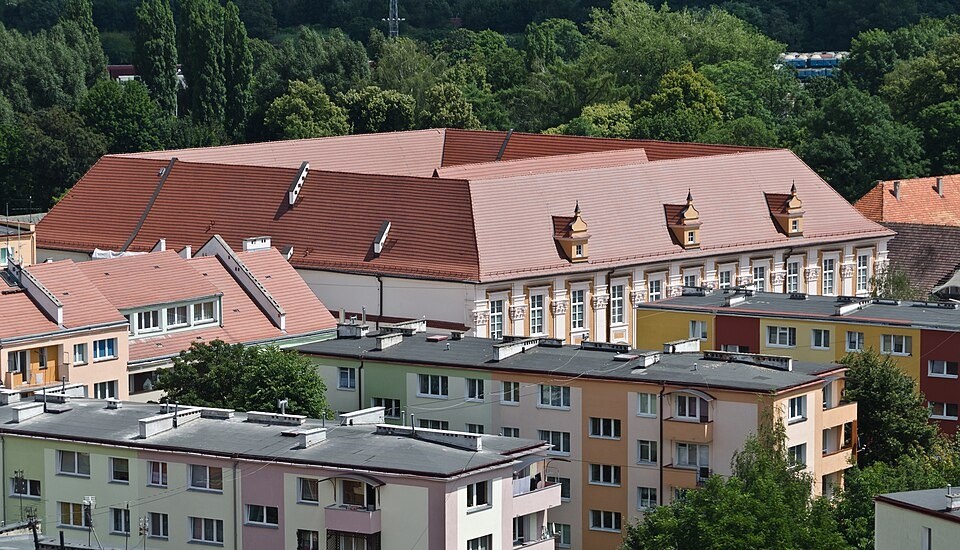
Cover: elevated view of the Bishop's Palace in Nysa, behind nearby buildings, 13 July 2014. Historic context, not the current entrance route. Photo: Jacek Halicki / Wikimedia Commons, CC BY-SA 3.0 PL. Resized and recompressed.
Nysa museum: plan around the winter timetable
Nysa's County Museum, Muzeum Powiatowe w Nysie, fills the Bishop's Palace at ul. Biskupa Jarosława 11. It is a substantial indoor visit rather than a single-room stop: the museum describes 30 rooms on three levels and recommends about one and a half to two hours. European paintings, decorative arts and archaeology make this a useful choice when you want more than a quick look at the city's buildings.
The most important winter detail is easy to miss. From 1 October to 31 March, Sunday opening is for groups arranged in advance, not a normal promise of walk-in admission. Wednesday remains the published free-admission day, but the late Wednesday closing belongs to the April-to-September timetable. These differences matter more than a generic opening-hours panel when planning an afternoon visit.
Winter hours and the last-entry difference
The museum's main hours page lists Tuesday to Friday, 09:00-15:45, with individual last entry at 14:45 and guided groups at 14:00. Saturday is 10:00-15:00, with individual last entry at 14:00 and guided groups at 13:30. Monday is closed. In the winter season, Sunday is 10:00-15:00 only when a group has been requested by Wednesday at 15:00.
There is a small but practical disagreement between official pages. The public-information bulletin gives weekday individual last entry as 15:00, while the main museum website says 14:45. Plan to the earlier 14:45 limit, not the extra fifteen minutes. Better still, arrive well before either cutoff if you want the museum's suggested full visit. Last admission is a deadline for entering, not a recommendation for how much time the displays deserve.
For a winter Sunday group, contact [email protected] before the Wednesday deadline and leave a phone number or email address so the museum can confirm. A request is not the same as a confirmed visit. Ask about the group's arrival time and whether a guide is included or separately booked. Do not assume that an individual visitor can simply join a group that has made the building open.
In summer, from 1 April to 30 September, the main page lists ordinary Saturday and Sunday hours of 10:00-15:00 and a longer Wednesday, 09:00-17:30. That is not the November timetable. Special closures can also override the normal week, so check the current hours page again when travelling around a holiday rather than relying on a saved screenshot.
Tickets, free Wednesday and discounts
The published combined ticket for permanent and temporary exhibitions is 20 zł standard or 15 zł reduced. A temporary-exhibitions-only ticket is 10 zł. The tariff also lists a reduced group ticket for groups of more than four people at 15 zł and a 5 zł ticket for holders of the Karta Dużej Rodziny, Poland's Large Family Card. Wednesday admission is free.
Bring the document supporting a concession. The museum lists school pupils, university and doctoral students, pensioners, disabled visitors with a carer, and holders of named senior and family cards among reduced-admission categories. These are eligibility rules, not an assurance that any foreign card will be accepted without checking. If your entitlement depends on a particular document issued abroad, ask the desk before budgeting around the discount.
Children under six have free museum admission, but the tariff excludes preschool groups taking part in museum lessons and workshops from that particular exemption. Separate activity charges exist. Published examples include 8 zł per pupil for a museum lesson, 12 zł per child for an art workshop and 20 zł per child for a family art workshop. Free admission should not be read as a blanket promise that organised activities or a guide cost nothing.
A time-limited offer runs until 31 December 2026: showing issue 100 of the magazine Archeologia Żywa entitles its holder to a reduced ticket for the full exhibition on one visit. The museum says the discount cannot be combined with other reductions and that the cashier stamps the designated page. This is a specific magazine-copy offer, not a general online voucher or an ongoing 2027 tariff.
English guiding: reserve several days ahead
An English guide is explicitly listed, which is helpful if you want the collections explained rather than relying on whatever translated labels happen to be available. The tariff quotes 150 zł for the whole exhibition in English and 100 zł for a selected part. The corresponding Polish-language fees are 80 zł and 50 zł. Request guiding several days in advance.
The visitor-planning page says guiding can be arranged for individuals and organised groups of up to 25 people. When enquiring, specify English, your party size, the date and whether you want the whole exhibition or selected rooms. Confirm the final admission-and-guiding total with the museum rather than assuming the listed guide fee replaces entrance tickets. The earlier guided-group entry limits also need to fit your booking.
The museum says a staff member accompanies visitors to indicate the direction of the route. That is useful practical support, but it is not the same thing as a reserved English-language tour. Make the language request explicit. A short visit focused on paintings or decorative arts may suit some visitors better than rushing every room, especially with children or a limited afternoon.
What to focus on inside the palace
The decorative-arts display offers a clear route into the collection without needing detailed local history. The museum describes nine rooms of art and craftsmanship, with furniture ranging across Gothic, Renaissance, Baroque, Rococo, Empire and Biedermeier styles. Look for changes in shape and decoration between chairs, cupboards, inlaid chests and writing furniture rather than treating them as an undifferentiated row of antiques.
Ceramics add another thread. The collection page lists Meissen and Sèvres porcelain, Dutch and Italian faience, Bolesławiec stoneware and faience from Prószków near Opole. Those regional objects give the display a useful connection to the wider area. The museum also describes Rococo and Empire clocks among the furnishings. Individual arrangements can change, so use this as a collection overview rather than a guarantee that a particular object will be in a particular room.
The separate European painting display is described as five rooms of sixteenth- to nineteenth-century work. Names listed by the museum include Otto van Veen, Anthonie Palamedes and Bartholomeus van der Helst. Be careful with attribution: its Judith is described as a work from the workshop of Lucas Cranach the Elder, not an unqualified autograph painting by Cranach. Reading the label closely is part of the pleasure here.
Archaeology supplies a different scale of history. The museum's collection account discusses prehistoric flint tools and material recovered from Nysa's urban excavations, including pottery, wood, leather and glass. These are descriptions of holdings and research, not a checklist of everything currently displayed. They help explain why an everyday shoe fragment or piece of household equipment can matter as much as a grand palace object.
Ovid's Metamorphoses: a dated reason to visit
The current exhibition OVIDIUS "Metamorfozy" is announced for 20 November 2026 to 9 January 2027. It combines the museum's holdings with loans from Wojciech Jakubczyk's private collection. The announcement gives a finissage date of 8 January, but no hour, so check event details before making a special trip for the closing event.
The museum section contains fifteen French prints illustrating the fifteen books of Metamorphoses, together with a frontispiece. The loan section includes fifty-two copper engravings made in Hendrick Goltzius's workshop. The display also crosses into other media: the announcement names a seventeenth-century Narcissus painting, an eighteenth-century Apollo and Daphne sculpture, an Italian maiolica vase showing Phaethon, and clocks with mythological subjects.
This gives a manageable theme for a visit: compare how a story is told on a densely composed print, a sculpture and a decorated household object. The exhibition essay also discusses Picasso and modern artists as wider examples of Ovid's influence. That context is not a statement that Picasso works or those contemporary installations are on display in Nysa. Plan around the objects actually named for this exhibition.
Lift access, facilities and the repair notice
The museum's access declaration, updated on 31 March 2025, describes entry from Biskupa Jarosława 11 through the gate and entrance passage. There is a bell to call a staff member, and the ticket desk is on the ground floor to the left after entering. The declaration lists a lift with a ramp, an adapted toilet and possible courtyard parking for a visitor with a disability. Its easy-to-read information also says the lift reaches exhibition rooms on the two upper floors.
There is an important current qualification. The website carries a notice about work repairing damage from the 2024 flood, including the entrance-passage floor, courtyard paving and selected interior rooms. It does not announce a blanket museum closure, but the published access declaration is not enough to guarantee every route during the works. If lift access, a smooth entrance or courtyard parking is essential, confirm the current route and assistance arrangements directly before travelling.
The declaration says there are no induction loops, Braille or high-contrast signs, or on-site sign-language interpreter. It describes assistance-dog access with a harness and the required status and vaccination documents. For specific needs, use [email protected] or +48 77 433 20 83 and explain what access you require, not simply whether the museum is "accessible".
A sensible first-visit plan
For an independent winter visit, choose Tuesday to Saturday, allow the recommended one and a half to two hours, and arrive comfortably before the earlier entry limits. Pick free Wednesday for admission savings, not a late opening. Choose a confirmed English guide if interpretation matters more than flexibility. Above all, settle Sunday-group arrangements and any essential access route before setting out: those are the details most likely to change whether this palace visit works for you.
Frequently asked questions
Can I walk in on a winter Sunday?
Do not assume so. October-March Sunday opening is for groups requested by Wednesday at 15:00, with contact details for confirmation.
Is Wednesday open late in winter?
No. Winter Wednesday hours are 09:00-15:45. The 17:30 Wednesday closing is listed for April-September.
Can I book an English guide?
Yes. Published English fees are 150 zł for the whole exhibition or 100 zł for a selected part. Request several days ahead and confirm admission charges separately.
Sources
- Seasonal hours and earlier entry limits
- Tickets, discounts and English guiding
- Visitor planning and guided group size
- Official bulletin with conflicting last entry
- Decorative arts
- European paintings
- Archaeology collection
- Ovid exhibition dates and contents
- Access declaration, March 2025
- Easy-to-read visitor information
- Flood-damage repair notice