Radomsko Regional Museum: Free Sunday, Lift Access and Farmstead
The essentials: Narutowicza 1. Mon-Fri 08:00-15:00; Sunday Oct-May 12:00-16:00, Jun-Sep 13:00-17:00. Last entry 30 minutes before closing. Normal 10 zł, reduced 5 zł, Sunday free. Main-museum lift via courtyard gate; jail and farmstead have separate barriers.
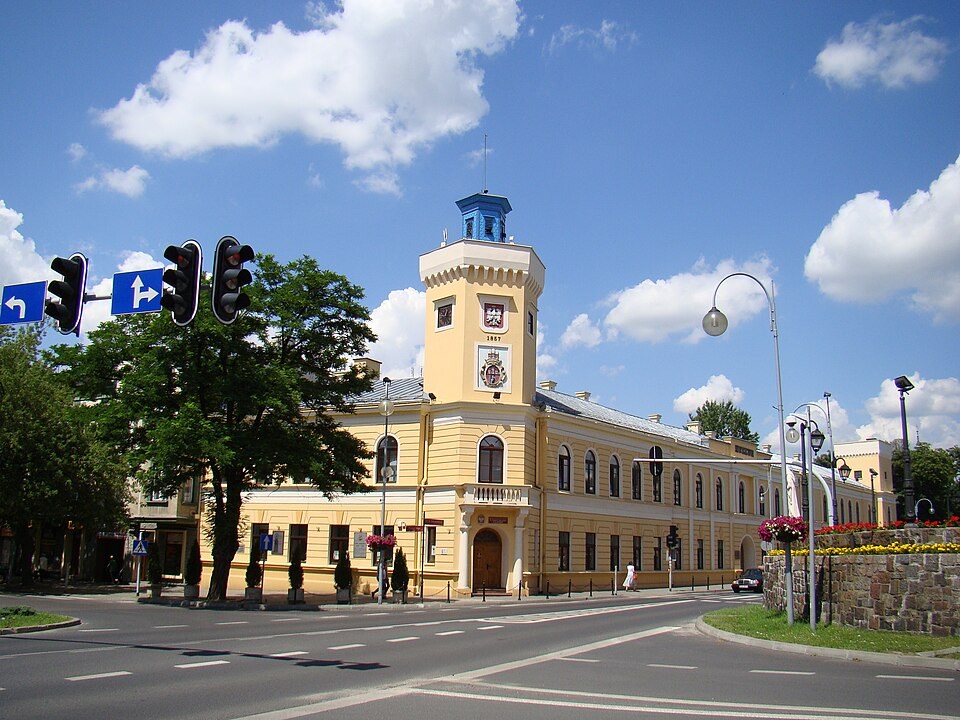
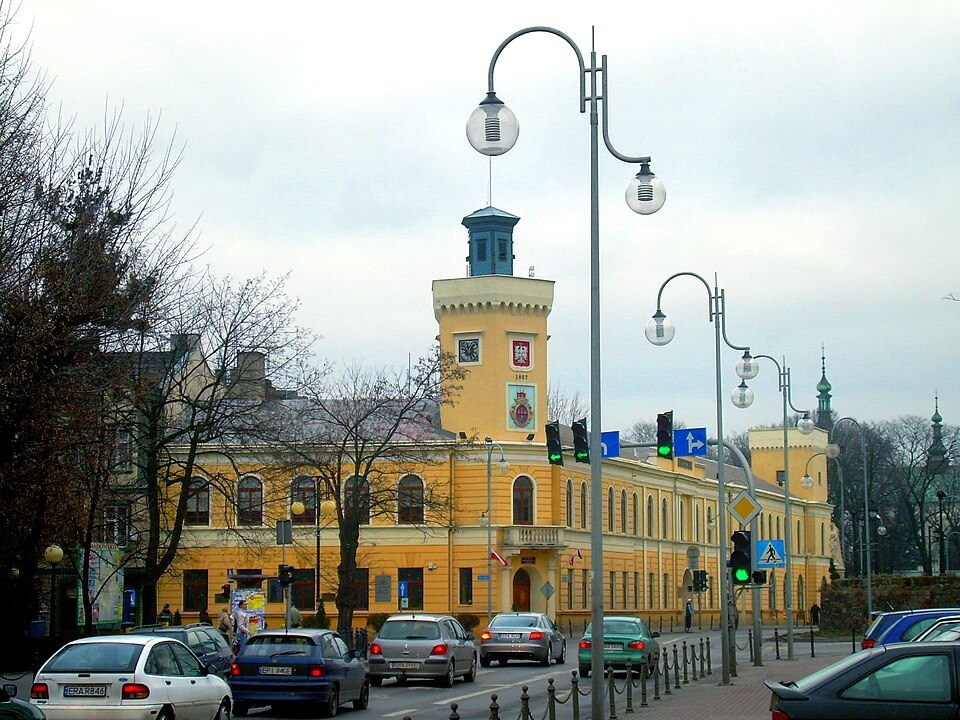
Cover: Radomsko town hall and regional museum, photographed 13 July 2014. Historic exterior, not a current entrance or access survey. Photo: Polar123 / Wikimedia Commons, CC BY-SA 3.0 PL. Resized and recompressed.
Radomsko's regional museum is a useful place to understand a town that is easy to pass through without learning much about. Its permanent displays connect local archaeology, the growth of industry, village life and the German occupation. The museum is based in the former town hall at Narutowicza 1, but some of its most important practical details concern separate buildings: the old municipal jail in the courtyard and the historic Zagroda Tatarska farmstead elsewhere in Radomsko.
Those locations do not have interchangeable opening or access arrangements. A lift serves the main museum, while the museum's own declaration says the jail is inaccessible to wheelchair users and describes serious barriers at the farmstead. Plan the parts you actually want to see, rather than treating one admission price as proof that everything will be open and reachable.
The main museum: hours and the last entry
The regular published hours are Monday to Friday, 08:00-15:00. Sunday hours change with the season: 12:00-16:00 from October through May, and 13:00-17:00 from June through September. There is no regular Saturday walk-in opening in that timetable. Organized groups can arrange other times, including Saturdays, by telephone.
The signed visiting rules dated 15 January 2026 add an easily missed detail: final visitors enter thirty minutes before closing. On a normal weekday that means 14:30; during the October-May Sunday timetable it means 15:30. Those are last admissions, not suggested arrival times for a full visit. Leave enough time to collect coats and finish before closing.
A separate Sunday information article still describes telephone reservations and a four-person limit. The current general hours and the 2026 rules do not repeat that limit. Do not rely on an old notice as a confirmed current capacity rule, but do call before making a Sunday journey if you need certainty about entry or a larger party.
Tickets: 10 zł normal, 5 zł reduced, Sunday free
The current price page and signed 2026 order agree: normal admission is 10 zł per person and reduced admission is 5 zł. The order covers permanent and temporary exhibitions at the museum, the former municipal jail and Zagroda Tatarska. These are the stated admission categories, not a promise that all three sites can be visited without separate arrangements on the same day.
The tariff says these admission fees do not cover the museum gallery. In exceptional circumstances the director can introduce an admission charge for the gallery. Check the notice for a particular gallery exhibition instead of assuming that a special event, opening or activity has the same conditions as ordinary museum admission.
Sunday is the free exhibition day in the 2026 order. Guiding, lessons and workshops are listed separately, so do not assume a free Sunday also makes those services free. The same order lists a guide at 30 zł for a group of no more than thirty, a museum lesson at 50 zł per group, and children's or school workshops at 10 zł per participant.
The visiting rules list free admission for children under seven and several documented categories, including Karta Polaka holders. Reduced admission includes pupils and students, people over sixty-five, pensioners, disabled visitors and their carers, among other categories. Bring the relevant proof and show it before purchasing. Ask the museum about an unfamiliar foreign document rather than assuming a translated card will qualify.
A local-history route, not only a town-hall photograph
The city-history exhibition covers Radomsko from its medieval town status through the interwar period. The museum describes copies of foundation records, privileges, guild agreements and the town's early seal, alongside original documents and objects. For a newcomer, these are a way into how local government, trades and institutions developed outside Poland's larger tourist centres.
One useful thread is transport and industry. The exhibition account connects the opening of the Warsaw-Vienna railway in 1848 with opportunities for Radomsko's growth, then follows metalworking and furniture manufacturing. Photographs of the Thonet factory and the Metalurgia works make that change local and visible rather than leaving it as an abstract story of industrialization.
Look for the older visual technology too. The museum describes a film projector brought to town in 1900, a portable stereoscope and a magic lantern. These give children and adults something concrete to discuss: how people watched pictures before screens became everyday objects. You do not need to read every document to follow that part of the exhibition.
Other permanent subjects to choose between
The permanent-exhibition list includes regional prehistory, rural life around the turn of the twentieth century, post-war Radomsko from 1945 to 1989 and the study of Stanisław Sankowski, the museum's patron. That range is useful when a family has different interests. You can build a visit around archaeology and everyday objects, or follow the town's later social history.
Sankowski's study opened in 2019 using private collections made available by his family. The museum describes his desk, publications, documents, spectacles and awards. This is a smaller, personal counterpoint to the civic and industrial displays. It helps explain why a regional museum preserves the work of an individual collector and teacher as well as older archaeological material.
Temporary exhibition listings can remain online after an opening. A report that a show opened on a particular date does not establish that it is still running. Check the current exhibition or news page for a closing date, and ask the museum if the show is your main reason for travelling. This guide does not turn an archived opening report into a current event recommendation.
The former jail: difficult history in a separate building
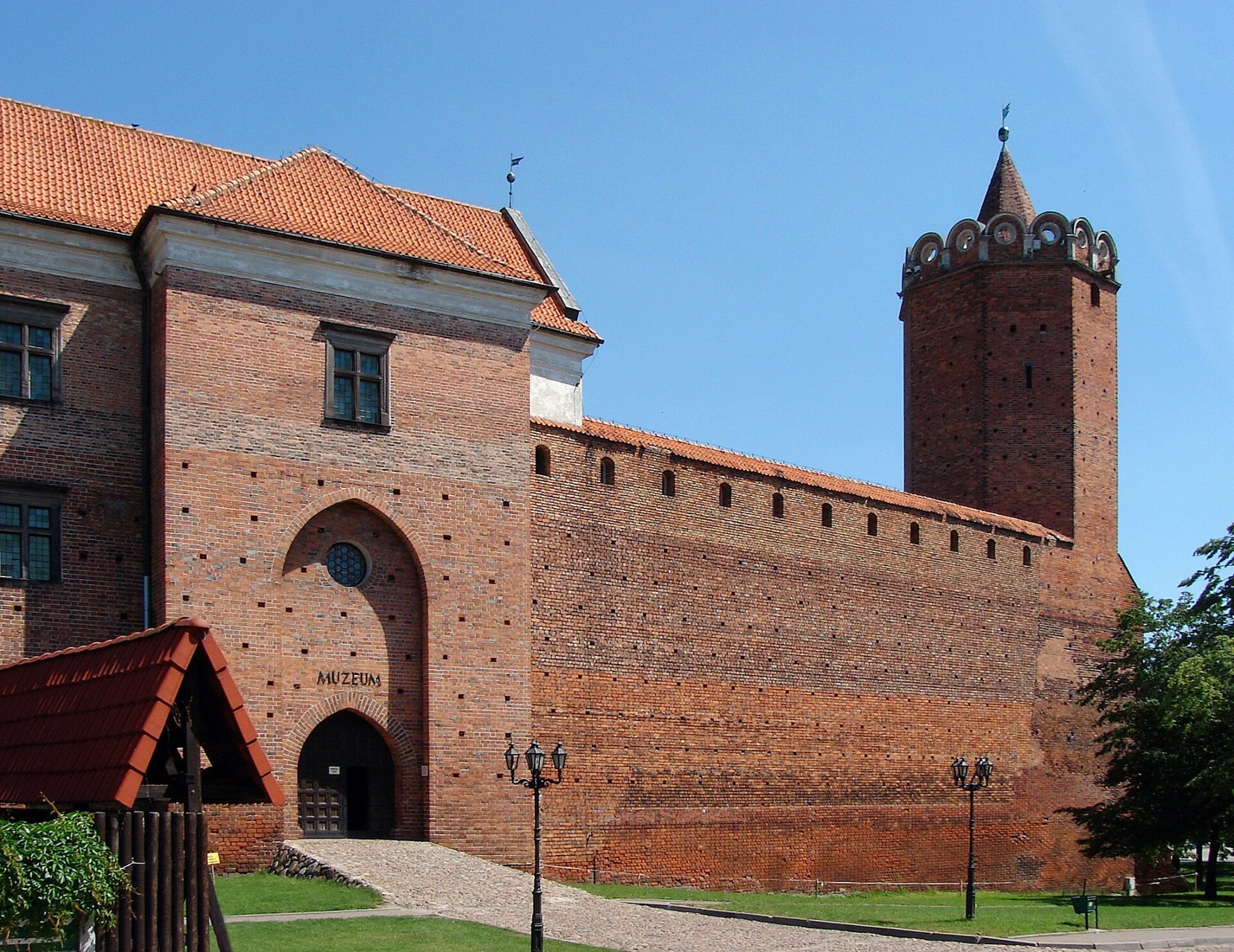
The courtyard's former municipal jail houses the permanent exhibition about occupied Radomsko. The museum says five of its six rooms or cells were adapted for archives and objects concerning the Second World War and German occupation. Subjects include the outbreak of war, German presence, underground education and the fate of Jewish residents confined in the ghetto.
This is a different kind of visit from the village-life or archaeology rooms. With children, decide in advance whether those subjects fit their age and questions. Do not assume that every display in a regional museum is a light family activity. You can ask staff about the exhibition's content and choose which parts to visit without trying to cover every room.
Access is also different here. The museum's declaration says the courtyard cobbles may be difficult, the jail entrance has a six-centimetre threshold, and the building is inaccessible to people with mobility disabilities. The main museum's lift does not remove those barriers. A virtual history exhibition is offered as another way of exploring parts of the town's wartime story.
Using the main museum's lift
The main entrance from Plac 3 Maja and Narutowicza has two steps and no ramp. There is also a threshold. The museum describes a different approach for the lift: use the gate at the end of the town-hall building, on the monastery side, near the marked disabled parking space.
An intercom at that gate has separate buttons for the museum and the civil registry office, with Braille labels. Use the museum button to ask for access to the courtyard lift. Exhibitions are upstairs. The declaration identifies an accessible toilet opposite the lift on that floor and another opposite the gallery entrance, although the gallery doorway itself has a small threshold.
Call before travelling if a working lift, door width or particular toilet arrangement is essential. The published declaration was reviewed in March 2026, but a written description cannot confirm the equipment's condition on your visit day. Tell staff what help you need and ask which entrance to use; do not struggle up the main steps because that is where a map pin leads.
English support: a virtual tour is not a promised live guide
The accessibility declaration says the virtual town-history exhibition has narration in Polish and English, plus a sign-language option. It also says a tablet is available on site for accessing that virtual exhibition. This is useful support for English-speaking visitors, especially if you want some historical context before looking at documents and objects.
It does not establish that every physical label is bilingual or that an English-speaking guide is available on demand. If live English interpretation matters, ask when arranging a guide and confirm the language explicitly. The published 30 zł group-guiding fee is not, by itself, a language guarantee.
Zagroda Tatarska needs its own arrangement
The historic farmstead is at Częstochowska 9 in Stobiecko Miejskie, now part of Radomsko. The museum says it is mainly active in summer for exhibitions, concerts, workshops and other events. Visits require prior arrangement by telephone on +48 44 685 00 76, by email or at the main museum. Do not transfer the town hall's Sunday timetable to this site.
The name has competing local explanations. The museum mentions a legend about Tatar prisoners and another interpretation connected with buckwheat, locally called tatarka. Presenting the name as proof of a particular community's settlement would overstate that evidence. The useful visitor focus is the surviving farmstead and the rural-life activities offered there.
The accessibility declaration describes uneven narrow approaches, large stones in the yard and very high thresholds at the cottage and toilet. It specifically says the toilet cannot be used by wheelchair users because of its entrance threshold. Ask about a workable visit before booking an activity, including the surfaces outside, rather than asking only whether a toilet exists.
Putting the visit together
For a straightforward first visit, start at Narutowicza 1, choose the permanent subjects that interest you and leave the farmstead for a separately confirmed appointment. Sunday can reduce admission cost, while a weekday offers an early opening. Neither replaces checking holiday changes or arranging a guide or access assistance.
The main contact is +48 44 683 56 51 and [email protected]. Mention your date, group size, language and access needs together. Large bags, umbrellas and coats go in the free cloakroom under the 2026 rules; food, drink, flash and tripod photography are restricted on the exhibitions. Arrive with time to look, not at the final-entry boundary, and let the different buildings' practical limits shape the day.
Frequently asked questions
Is the whole museum step-free?
No. The main museum has a courtyard lift, but the declaration describes the former jail as inaccessible to wheelchair users and serious barriers at the farmstead.
Can I visit Zagroda Tatarska without booking?
Arrange it in advance. The museum says the farmstead mainly opens for summer events and agreed visits.
Is an English guide guaranteed?
No live English guiding is confirmed. The museum offers an English-narrated virtual history exhibition and an on-site tablet.