Wieluń Museum: Free Sunday, Winter Saturdays and Tower Access
The essentials: Narutowicza 13. Standard 15 zł, reduced 8 zł, family 40 zł; Sunday exhibitions free. Winter Saturdays require a group of more than ten booked seven days ahead. Męczarnia exhibitions April-October only, never Sunday. Main museum has stairs and no lift.
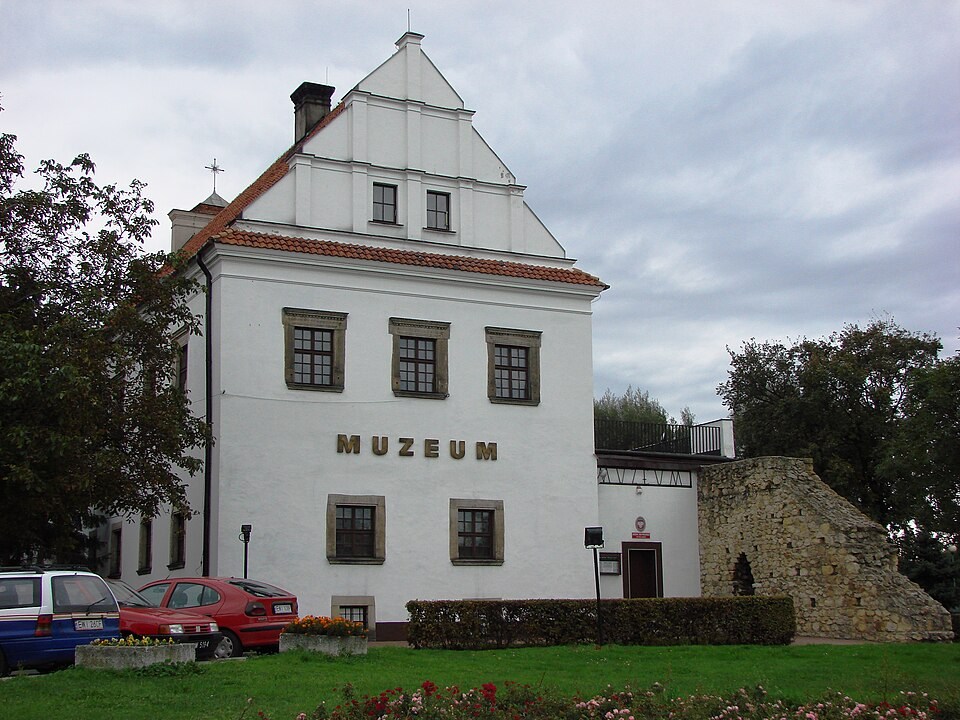
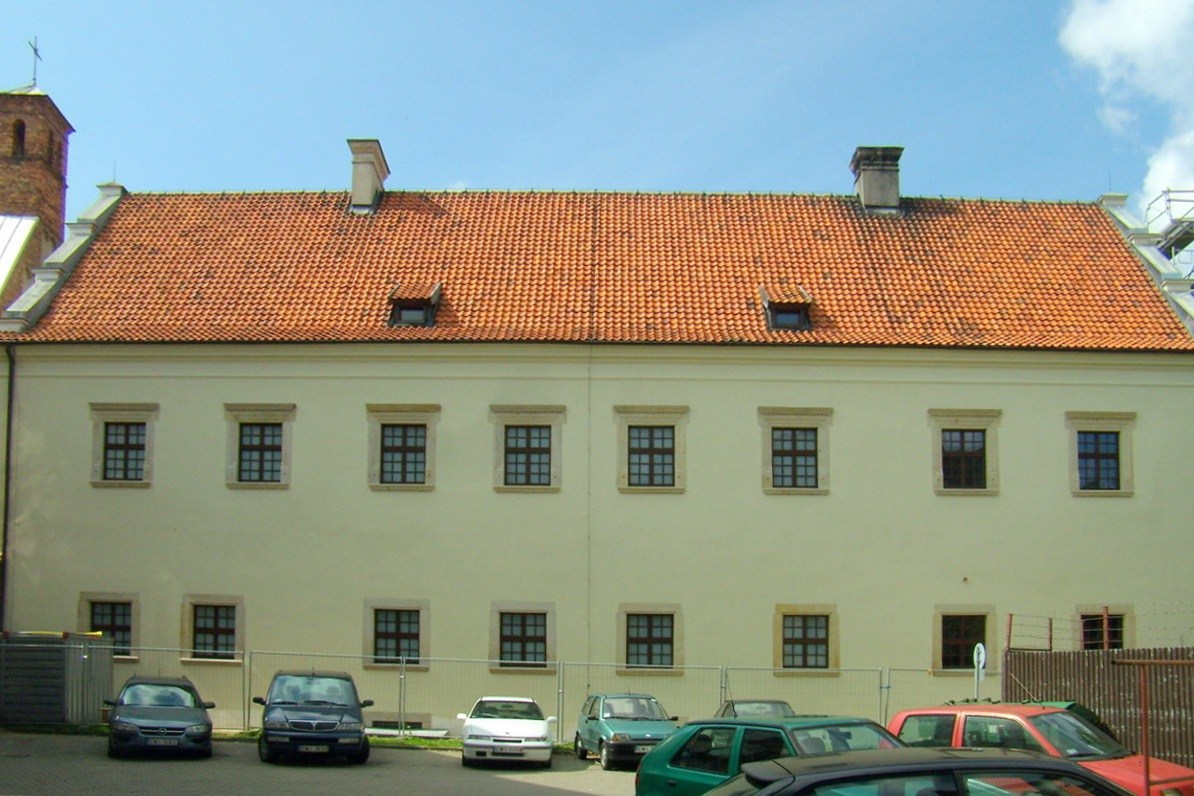
Cover: Wieluń regional museum, photographed 9 January 2007. Historic exterior, not a current access survey. Photo: Piotr Torchała / Wikimedia Commons, CC BY-SA 3.0. Resized and recompressed under the same licence.
Choose the museum day before choosing the tower
Wieluń's regional museum is a useful stop for families who want more than a quick photograph of the town walls. Its main building brings together the bombing of September 1939, archaeology, rural households and a children's history space. But the practical detail that can change an entire visit is the calendar: a free Sunday at the museum does not include an open Męczarnia tower, and winter Saturdays are not ordinary drop-in days.
Start with the main museum at Narutowicza 13. The institution's opening-hours page separates this building from Ożarów manor and the tower. Those are different visits with different restrictions. If you have found several attractions under the same museum name, do not assume a single timetable or a single admission price covers everything.
For an uncomplicated winter visit, a weekday or Sunday is the stronger starting point. For a tower visit, first check its seasonal page and arrange the rest of the day around confirmed access. That distinction matters especially when travelling with children who have been promised a climb.
Hours, last admission and the winter Saturday rule
The published main-building hours are Monday, Wednesday and Thursday 09:00-16:00; Tuesday and Friday 09:00-17:00; Saturday 09:00-16:00; and Sunday 11:00-17:00. Last admission is 30 minutes before closing. These are the museum's visitor hours, not its administration hours, which appear separately on the same page.
The Saturday line needs its qualification. From 1 November to 31 March, the museum opens on Saturdays only for a group of more than ten people registered at least seven days beforehand. A couple or family arriving without an arrangement should not read the headline Saturday hours as a promise of entry. Nor should a group of exactly ten assume it meets a rule written as more than ten.
Call +48 43 843 43 34 before a journey that depends on a particular exhibition or holiday opening. The timetable is a sensible planning baseline, but it does not establish that every room or activity will operate on a particular date. Leave time beyond the last-entry cutoff; reaching the desk just before it does not leave much room for a thoughtful visit.
What tickets cost and what Sunday makes free
The current tariff lists standard admission at 15 zł and reduced admission at 8 zł. A family ticket costs 40 zł for two adults and children, with a maximum of six people. Karta Dużej Rodziny prices are 10 zł standard and 5 zł reduced. Bring the document supporting any discount rather than expecting the desk to infer eligibility.
Every Sunday, entry to exhibitions is free. Keep that statement separate from paid services: the museum also lists guided visits, workshops, lessons and concerts. A free exhibition day is not a blanket promise that all organised activities are free. The tariff gives a museum guide price of 60 zł for a group of up to 30; the city-guiding offer is priced separately by each started hour and is offered to people buying museum admission.
The regulations page links a scanned director's order dated 17 July 2025, effective 1 August 2025, which confirms the 15/8 zł museum prices and the 40 zł family ticket. It is a price amendment, not a readable complete visitor handbook. Do not treat that download as proof of rules on photography, bags or pushchairs that it does not actually spell out.
A former convent with an industrial and multicultural past
The building's own history adds meaning to the exterior. Anna Koniecpolska founded the Bernardine convent, and construction under Jerzy Hoffman took place in 1613-1615. The present museum is therefore not a purpose-built gallery inserted into an otherwise anonymous block.
After the sisters moved in 1819, the former convent entered private hands. Belgian entrepreneurs Karol Neuville and his son Hubert established a cloth manufactory that employed as many as 250 workers. After a fire in 1844 the building became Russian military barracks. Its interwar uses included housing, the Miraż cinema and a hall used by the Jewish Makkabi gymnastics and sports association.
Later, a woodworking business occupied the building, and another fire in 1959 left it empty. A major conversion in 1964-1969 prepared it for museum use, giving it a Renaissance character informed by the period of its origins. The window surrounds were reconstructed following the discovery of a blocked-up original portal. Looking at the facade, it helps to recognise this sequence of reuse and restoration rather than assume every visible detail has survived untouched since the seventeenth century.
September 1939 through witnesses and ordinary objects
The permanent exhibition Świadkowie mówią… Wieluń 1 września 1939 describes the Luftwaffe attacks on the town and the first weeks of German occupation through survivors' accounts. Written memories, audio-video testimony and reconstructed fragments of the town make the experience more personal than a sequence of military dates.
Objects connect that history to everyday life. The museum describes photographs, residents' documents, civic seals and objects associated with the town's religious communities. Its account of interwar Wieluń includes Catholic, Jewish, Protestant and Orthodox life. Jewish ceremonial objects and photographs of the synagogue sit within a history that also addresses the ghetto and the deportation of Wieluń's Jews.
For parents, this is a reason to prepare rather than avoid the exhibition automatically. Bombing, occupation and the destruction of communities can raise questions that need time. Decide how much of the material fits your child, and leave room to stop. Do not present the entire museum as light entertainment simply because another section has puzzles and play stations.
What younger children can do
Dotknij historii Wielunia, or Touch Wieluń's History, is a family exhibition conceived particularly for ages four to nine. Its subject runs from the town's foundation legend to the fifteenth century. The museum describes an animated legend, a hologram of a local denarius, interactive educational stations, puzzles, mazes and movement-based activities.
Keep the foundation story in its proper category: it is a legend used to introduce the town's medieval past, not proof that the events happened exactly as the animation tells them. The family space is a useful contrast to the wartime exhibition, allowing a visit to have a different pace and tone without pretending that every gallery is aimed at the same audience.
Ask whether the family space is available for individual visitors on your chosen day, especially around organised groups. The published description establishes its intended audience and contents; it does not guarantee English narration, English instructions or staff-led play at every session. If language support matters, settle it before setting a child's expectations.
Archaeology and a reconstructed rural household
The archaeological exhibition follows the region from stone tools through Bronze Age objects, Roman-period material and medieval finds. Among its specific objects are metalworking tools from a smith-goldsmith's grave, Roman imports and material from settlements and cemeteries around the region. These are good prompts for a slower family conversation about making things, trade and everyday work.
The rural-life exhibition focuses on the turn of the nineteenth and twentieth centuries. A partially reconstructed wooden cottage, cheese press, butter moulds, coopered vessels and a loom show how much household work took place at home. The reconstructed rooms are exhibition interpretation, not an untouched house brought forward unchanged.
Look for the difference between practical and decorative objects. The museum explains that some plates, cups and stacked pillows were primarily decorative, while tools and food-making equipment show a household's productive work. For children, choosing one unfamiliar object and working out its use may be more rewarding than rushing to name everything.
Męczarnia is seasonal, separate and stair-heavy
The tower's dedicated page says its exhibitions are available from April to October. It also lists weekday access 09:00-15:00 after buying a ticket at the museum, Saturday access only for organised groups of at least ten booked no later than two days before, and no Sunday visits. The general hours page omits the seasonal sentence, so do not turn its weekday line into a promise of winter opening.
Tower admission is 7 zł standard or 5 zł reduced. Its displays concern the executioner's work and historical weaponry. Torture instruments are part of the subject, so a tower-shaped building does not automatically make this a suitable children's attraction. The upper floors and viewpoint require long, steep stairs, with no lift and no toilet in the tower.
Access checks before travelling
The museum's published accessibility declaration describes steps at the main entrance, further stairs to the museum ground-floor reception and exhibition rooms, a longer staircase to basement galleries and the toilet, and long, steep stairs upstairs. There is no lift. A ground-floor exhibition therefore does not mean a step-free route from the street.
The declaration also reports no induction loops or on-site or online sign-language interpreter, and permits guide dogs. It is an older self-assessment, dated 2020 with website dates in 2022, rather than a recent independent inspection. If wheelchair access, a usable toilet, pushchair storage or a quieter route determines whether a visit works, ask staff for current details. Build the outing around what they can actually offer, not around the accessibility arrangements at Ożarów, which is a different building.
For most independent winter visitors, the clearest plan is a main-museum visit on Sunday or a weekday, with selected galleries and time outside to look at the building and town walls. Leave the tower as a separately confirmed seasonal visit. That produces a day based on what is open, rather than a chain of assumptions about attractions sharing the same museum name.
Frequently asked questions
Does free Sunday include the tower?
No. The tower is not open on Sunday; its exhibitions are seasonal April-October.
Can a family drop in on a winter Saturday?
The published rule limits November-March Saturdays to groups of more than ten booked at least seven days beforehand.
Is the main museum step-free?
No. Its declaration describes entrance and internal stairs, including access to the museum ground floor, and no lift.