Stargard Basteja Museum: Tickets, Languages and Access
The essentials: Basteja, Park Piastowski 1, costs 15/8 zł; both museum buildings 20/10 zł. Tue–Fri and Sun 10:00–16:00, Sat 10:00–14:00, Mon closed. Thursday free admission. Individual audio guides: Polish/German, free. Basteja has a lift and adapted toilets; confirm market-square exhibition access.
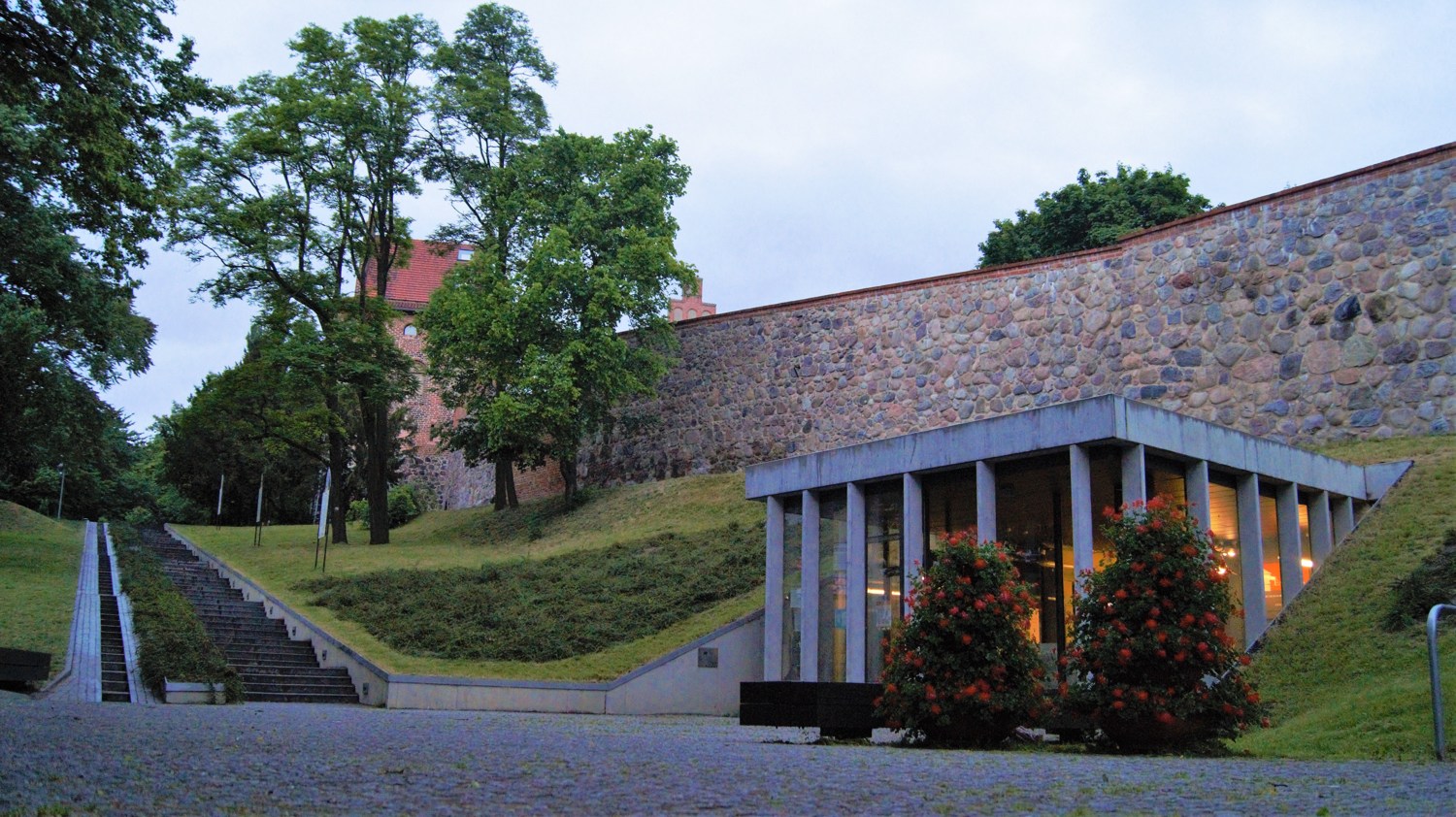
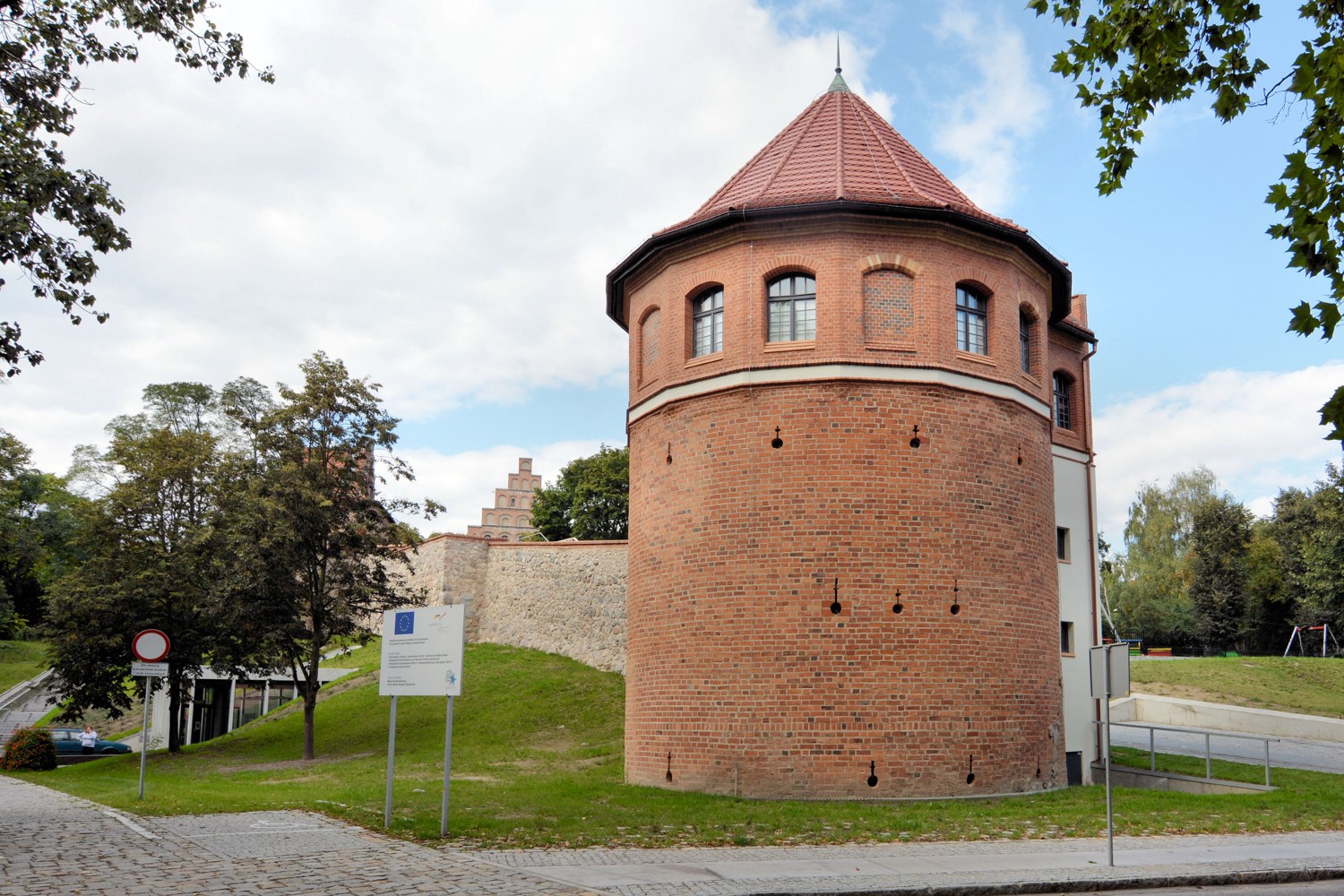
Cover: Basteja museum entrance beside Stargard's defensive walls, photographed 19 June 2015. Historic exterior, not a current access survey. Photo: Małgorzata Jakubowska / Wikimedia Commons, CC BY-SA 4.0. Resized and recompressed.
Stargard's museum is not one door with one ticket. The Basteja branch at Park Piastowski 1 puts the city's history inside its old defensive setting, while the museum at Rynek Staromiejski offers another route through the past. For a first visit, the useful questions are which building suits your interests, whether you want both, and how language or access requirements change the plan.
Basteja admission is currently listed at 15 zł standard or 8 zł reduced. The museum's linked tariff also lists a two-building ticket at 20/10 zł. Thursday is the published free-entry day, Saturday closes earlier than the other open days, and Basteja's free audio guides are described in Polish and German, not English. Those details matter more than a vague promise of an easy museum afternoon.
Choose the right building before choosing a ticket
Basteja is at Park Piastowski 1. Its permanent exhibition, Stargard – miejsce z historią, follows the city from its medieval beginnings towards the early twentieth century. The museum describes four exhibition levels, starting at level -1 with the earliest history and moving through later periods. The walls and tower outside help connect the displays to the city around them.
The main museum is a separate stop in the old market square. Institutional contact details use Rynek Staromiejski 2–4, while the permanent-exhibition description and current event listings identify visitor exhibitions at Rynek Staromiejski 3. Use the named exhibition and number 3 when asking about the visitor entrance, and confirm your meeting point if you have a group booking. Do not mistake the institution's postal address for Basteja's entrance.
The official temporary-exhibition page lists a market-square exhibition beginning June 2, 2026 and continuing to June 2029. That is useful evidence against assuming the market-square museum is simply unavailable because an older third-party guide says Basteja is the only open branch. Check current museum announcements for your date rather than copying an undated closure description.
Hours: Saturday is the short day
The museum's current hours page gives a shared ordinary timetable for Basteja and the museum at Rynek Staromiejski. Monday is closed. Tuesday, Wednesday, Thursday and Friday run from 10:00 to 16:00. Saturday runs from 10:00 to 14:00, while Sunday returns to 10:00–16:00. Thursday carries the free-admission notice.
The shorter Saturday is easy to miss when planning a trip from another city. A late lunch followed by two museum buildings may not fit. Start with the building you most want to see, then decide whether the second remains realistic. The official hours panel does not give a last-entry deadline, so ask about it rather than assuming you can begin a full route immediately before closing.
Special notices can override the ordinary timetable. For example, the museum's homepage retains a notice closing Basteja for a conference on October 22, 2026. That is a dated exception, not an ongoing closure. Equally, the lack of a closure on your remembered timetable does not guarantee opening on a public holiday. Check the latest announcements before travelling.
What the current ticket order actually covers
The detailed document linked from the hours page is director's order 12/2025, issued November 3 and effective November 10, 2025. It lists the main building at 10 zł standard or 6 zł reduced, and Basteja at 15 zł standard or 8 zł reduced. A ticket for both MAH and Basteja is listed at 20 zł standard or 10 zł reduced. These are the published amounts, not an assumption that the two sites share one basic ticket.
For a standard adult visitor, buying the two ordinary admissions separately totals 25 zł, compared with the listed 20 zł combined ticket. For a reduced visitor, the separate amounts total 14 zł, compared with 10 zł combined. Ask how the combined ticket is issued and when it must be used; the tariff alone does not settle whether it can be split across different days.
The family products are different again. The main-building family ticket is 25 zł and Basteja's is 40 zł, for a maximum of five people including no more than two adults. Do not read the family figure as a per-person charge or assume there is a combined family product when the order does not list one. Ask staff to compare the available options for your actual party, particularly if some children qualify for free entry.
Discounts and free entry need the right documents
The order lists free admission for children under seven, excluding organised groups, as well as several other eligible groups. It also names carers of disabled visitors and carers of organised groups. Bring evidence relevant to the category you intend to use and ask how staff apply it to your visit. A family resemblance or a verbal description is not a substitute for a concession document.
Reduced eligibility includes specified school, student and doctoral categories, and certain older visitors, pensioners, disabled visitors and teachers, with conditions set out in the order. Some categories refer to nationality or the education system concerned. Foreign residents should check their particular document rather than assuming every student or senior card is accepted on identical terms.
Local cards have their own prices. The Stargard resident card and Stargard large-family card list 9/6 zł for Basteja and 6/3 zł for the main building. The Stargard senior card lists 6 zł for Basteja and 3 zł for the main building. These local products are not interchangeable with a general overseas senior discount or every Polish large-family card.
Thursday is useful, but services are separate
The museum's hours page marks Thursday as free admission, and the regional tourism portal independently confirms free Thursday visits at Basteja. That makes Thursday attractive if your schedule is flexible. It does not turn every lesson, escape room or booked service into a free activity. Ask about any special exhibition or additional service you specifically intend to use.
The linked tariff prices a live guide at admission plus 10 zł per person, only for organised groups. It lists museum lessons separately at 15 zł per person. A family visiting independently should not assume a guide is waiting for the same supplement, or that a Thursday admission offer includes a workshop. Arrange the service, language and total before treating it as part of the day.
What to look for inside Basteja
The museum describes more than 300 objects alongside around 1,000 images, maps, archival items, documents, photographs and postcards presented through multimedia. Start below ground with the medieval city, then let the route explain why Stargard's position, institutions and trade mattered. Looking for a change in the city's shape is often more rewarding than trying to remember every date.
One part of the exhibition brings together religion, sacred art and learning. Maps and views establish the urban setting; objects from local churches and material about scholars and clergy show other forms of civic life. The museum highlights a processional cross dated around 1330 and associated with the Lübeck workshop of Johann Apengeter. Ask about the current display if one object is your main reason for visiting.
Another section follows government, crafts and commerce. The museum describes imported household objects, trade seals, coins and material about Hanseatic connections. Later parts address war and fire in the seventeenth century, followed by the city's industrial-era development. This gives a mixed-interest group several ways in: buildings, work, domestic life, transport or the effects of conflict.
Polish and German audio, with limited English evidence
The current ticket order explicitly describes free Basteja audio-guide rental in Polish and German, with tracks for children and adults, for individual visitors only. It does not list an English audio track. If English narration is essential, confirm what is currently available before buying a ticket or making a special journey. An English-language museum homepage does not establish English interpretation throughout the galleries.
The regional tourism portal describes Polish and German exhibition text and says the first two display units also have English. Treat that as limited English coverage, not a promise of a fully translated route. You may still enjoy the objects, maps and visual material, but it helps to know beforehand whether you are comfortable with partial translation. Ask staff about suitable support for your group.
Access differs sharply between the buildings
The museum's access page describes Basteja with a flat approach from the main entrance, a lift and adapted toilets. It also describes induction loops in the exhibition and audio guides with audio description. These are concrete reasons to consider Basteja first if mobility, hearing or sight support shapes your choice. Confirm essential equipment is operating and that the route suits your particular needs.
The market-square description is less reassuring: it says there is no ramp into the building and no lift, while also mentioning a flat approach to reception. That distinction matters. Reaching the desk is not the same as reaching every exhibition. Ask which rooms can be visited without steps and what alternatives exist before assuming the two-building ticket creates two equally accessible visits.
What the market-square museum adds
The permanent-exhibition page describes a history-of-pharmacy exhibition at Rynek Staromiejski 3. Its sections include older pharmacy vessels, furnishings from the local Pod Złotą Gwiazdą pharmacy dating to 1889, and equipment used for preparing medicines. This is a different emphasis from Basteja's broad city-history route. Check its current availability if the pharmacy collection is your priority.
The temporary exhibition Stargard – miasto co dobrami się chlubi i z nich słynie follows the city from its thirteenth-century charter period to the early eighteenth century. The museum describes objects borrowed from institutions around Poland, together with models, reconstructions, sensory stations and multimedia. The published end month is June 2029, but individual access and opening notices still need checking.
Build a visit around your strongest interest
Choose Basteja alone for the defensive setting and a broad narrative through city history. Consider the combined ticket if the market-square collections also appeal and you have enough time within the shorter day's timetable. With children, pick a few themes rather than treating every screen as a task to finish. The free child audio track is described in Polish and German, so language remains part of that decision.
For practical questions, the museum lists 91 578 38 35 and [email protected]; from a foreign phone add +48. Before travelling, settle the building, ticket scope, language support and any essential access need. That small amount of planning avoids arriving at the wrong address or discovering that the service you wanted was never included in ordinary admission.
Frequently asked questions
Is Basteja free on Thursday?
Thursday is the published free-admission day. Check booked services and any special exhibition separately.
Is there an English audio guide?
The current tariff lists free Polish and German audio for individual visitors, not English. The regional tourism page describes only limited English display text.
Is Basteja accessible?
The museum describes a flat main approach, lift, adapted toilets, induction loops and audio description. Confirm essential equipment and support before visiting.